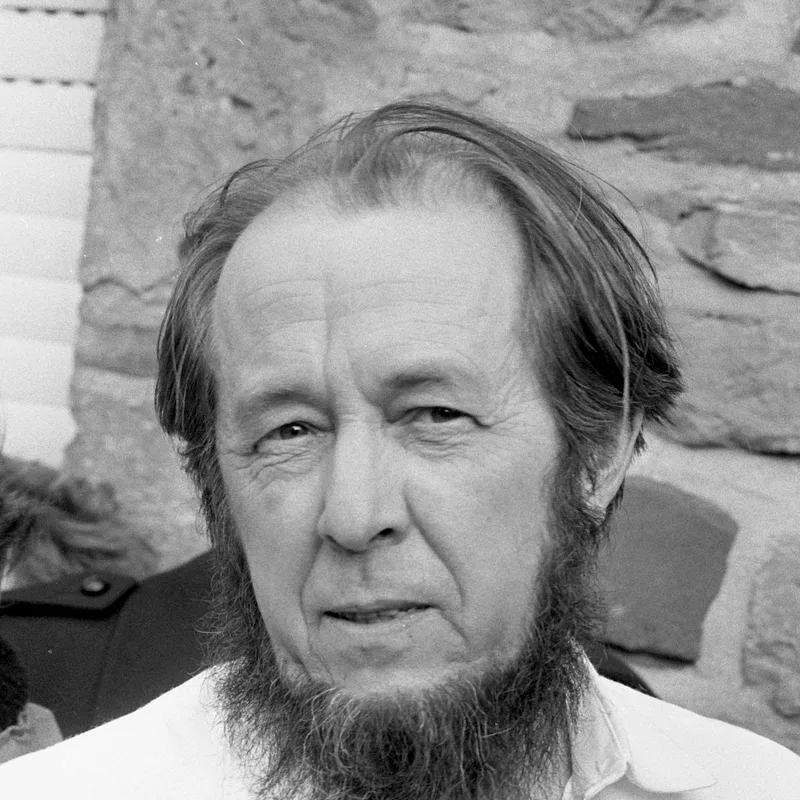
Aleksandr Solzhenitsyn
Writer, Dissident, 1918–2008
Russian Orthodox
What is the meaning of life?
Good and evil run through every heart, not between groups.
Solzhenitsyn was an artillery officer in the Red Army when, in 1945, he was arrested for criticising Stalin in a private letter; he spent eight years in labour camps and three more in internal exile. His novella One Day in the Life of Ivan Denisovich (1962) and his history of the Soviet camp system, The Gulag Archipelago (1973), made him world-famous and got him expelled from the Soviet Union in 1974. He won the Nobel Prize in Literature in 1970. Prison taught him that evil is not the property of some other group of people: the line between good and evil runs through every human heart.
-
“…the line dividing good and evil cuts through the heart of every human being.”1
What is the meaning of the universe?
Men have forgotten God; that is why disaster came.
Solzhenitsyn was raised in the Orthodox faith by his mother, became a convinced Marxist as a young man, and found his way back to Christianity in the camps. Accepting the Templeton Prize in 1983, he recalled hearing older people explain Russia's catastrophes in one sentence: men have forgotten God. After some fifty years of studying the Revolution, he said, he could find no more accurate explanation, and he saw the same forgetting at work in the materialism of the West.
-
“Men have forgotten God; that's why all this has happened.”2