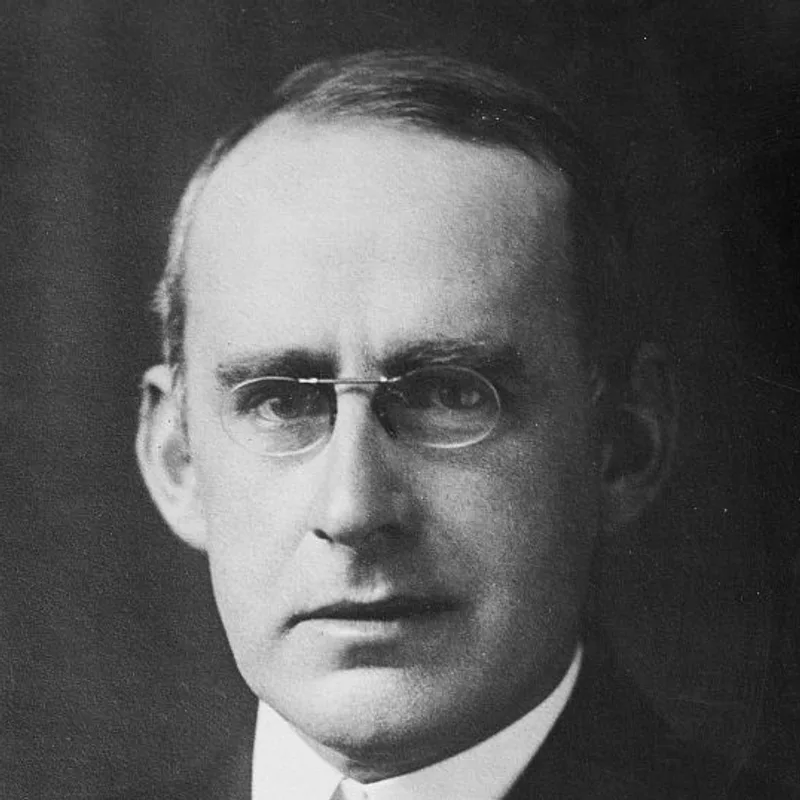
Arthur Eddington
Astrophysicist, 1882–1944
Quaker mystic
What is the meaning of life?
The scientist, like the mystic, follows a true light.
Eddington was the leading astrophysicist of his day: he was among the first to suggest that the stars are powered by the fusion of hydrogen into helium, and in 1919 he led the eclipse expedition that confirmed Einstein's prediction that gravity bends light, making Einstein world-famous overnight. He was also a lifelong Quaker, and in his Swarthmore Lecture, Science and the Unseen World (1929), he argued that the scientist's search for truth belongs to the same family of experiences as the mystic's: the desire for truth, the reaching of the spirit beyond itself, the response to beauty, the Inner Light of conviction. As truly as the mystic, he said, the scientist is following a light, and it is not a false or an inferior one.
-
“As truly as the mystic, the scientist is following a light; and it is not a false or an inferior light.”1
-
“The desire for truth so prominent in the quest of science, a reaching out of the spirit from its isolation to something beyond, a response to beauty in nature and art, an Inner Light of conviction and guidance — are these as much a part of our being as our sensitivity to sense impressions?”1
What is the meaning of the universe?
The stuff of the world is mind-stuff.
In The Nature of the Physical World (1928) Eddington argued that modern physics had dissolved the solid objects of common sense into a world of symbols and shadows: physics describes the structure of things, not what they are. The one place where we meet reality directly is our own consciousness, and from this he drew a bold conclusion: the stuff of the world is mind-stuff, the universe being of the nature of a thought or sensation in a universal Mind. He was careful to add that physics could not prove God; but it had, he thought, stopped ruling the spirit out.
-
“The universe is of the nature of a thought or sensation in a universal Mind … To put the conclusion crudely — the stuff of the world is mind-stuff.”2