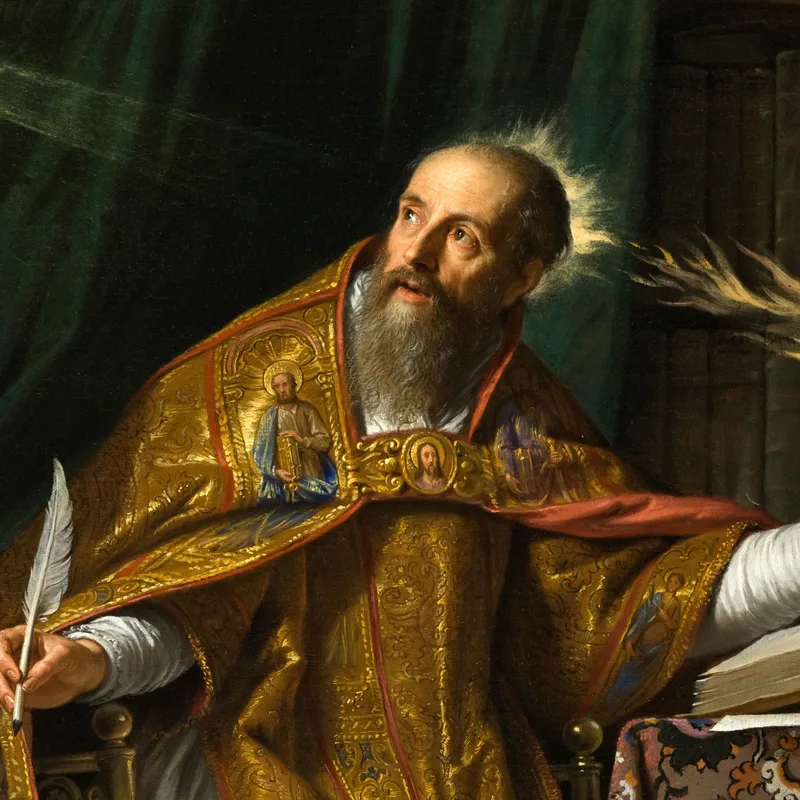
Augustine of Hippo
Bishop of Hippo, Theologian, Philosopher, 354–430
Christian Platonist
What is the meaning of life?
Our heart is restless until it rests in God.
Augustine's answer grew out of the story he tells in the Confessions (c. 397–400): years of ambition and pleasure, about nine years as a Manichaean hearer, then the Neoplatonists and conversion to Christianity in Milan in 386. The book opens with its thesis: God made us for himself, and the heart cannot rest anywhere else. Everyone wants a happy life, he argues in Book X, and the happy life is joy in the truth, which is God. What counts in action is the direction of love — love, and do what you will — and the City of God, finished in 426, ends with the goal of the whole human story: to rest in God, to see, love and praise, in an end without end.
-
“Thou awakest us to delight in Thy praise; for Thou madest us for Thyself, and our heart is restless, until it repose in Thee.”1
-
“A happy life is joy in the truth: for this is a joying in Thee, Who art the Truth, O God my light, health of my countenance, my God. This is the happy life which all desire; this life which alone is happy, all desire; to joy in the truth all desire.”2
-
“Once for all, then, a short precept is given thee: Love, and do what thou wilt: whether thou hold thy peace, through love hold thy peace; whether thou cry out, through love cry out; whether thou correct, through love correct; whether thou spare, through love do thou spare: let the root of love be within, of this root can nothing spring but what is good.”3
-
“There we shall rest and see, see and love, love and praise. This is what shall be in the end without end. For what other end do we propose to ourselves than to attain to the kingdom of which there is no end?”4
What is the meaning of the universe?
Made from nothing by a good God; evil is only missing good.
Augustine's universe is created: God made heaven and earth out of nothing — not out of himself, and not from matter that was already there — and the world itself bears witness that it is not God but was made by him. Whatever exists is good to the extent that it exists. This answered the question that had drawn him to the Manichees, where evil comes from: evil is not a substance at all, only the loss of good. Time is a creature too: the world was made with time, not in it, so there was no "then" before creation in which God sat idle, and God lives in an ever-present eternity — though Augustine admitted that he could not say what time is.
-
“I asked the whole frame of the world about my God; and it answered me, "I am not He, but He made me."”5
-
“Behold, the heavens and the earth are; they proclaim that they were created; for they change and vary. … Thou therefore, Lord, madest them; who art beautiful, for they are beautiful; who art good, for they are good; who art, for they are; yet are they not beautiful nor good, nor are they, as Thou their Creator art; compared with Whom, they are neither beautiful, nor good, nor are.”6
-
“At no time then hadst Thou not made any thing, because time itself Thou madest. … What then is time? If no one asks me, I know: if I wish to explain it to one that asketh, I know not.”7
-
“So long therefore as they are, they are good: therefore whatsoever is, is good. That evil then which I sought, whence it is, is not any substance: for were it a substance, it should be good.”8