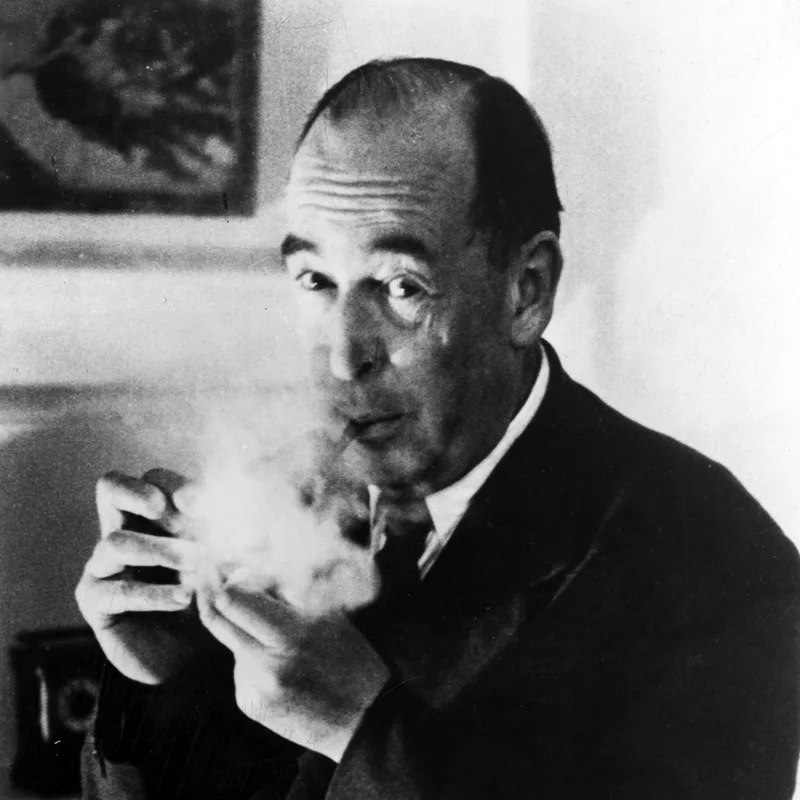
C. S. Lewis
Novelist, Literary scholar, Christian apologist, 1898–1963
Anglican
What is the meaning of life?
To find our joy in God; we were made for another world.
Lewis held that people are made by God and for him, so nothing else can finally satisfy them. In Mere Christianity (1952), adapted from radio talks he gave on the BBC during the Second World War, he compared a person to an engine built to run on one fuel: God is the happiness people look for everywhere else. His own life gave him the clue: the stabs of longing he called Joy, traced in his memoir Surprised by Joy (1955), pointed past anything this world can give. In the sermon "The Weight of Glory" (1941) he added that our desires are not too strong but too weak, and that every person we meet is an immortal, on the way to splendour or to horror.
-
“God made us: invented us as a man invents an engine. A car is made to run on petrol, and it would not run properly on anything else. Now God designed the human machine to run on Himself.”1
-
“If I find in myself a desire which no experience in this world can satisfy, the most probable explanation is that I was made for another world.”2
-
“We are half-hearted creatures, fooling about with drink and sex and ambition when infinite joy is offered us, like an ignorant child who wants to go on making mud pies in a slum because he cannot imagine what is meant by the offer of a holiday at the sea. We are far too easily pleased.”3
-
“There are no ordinary people. You have never talked to a mere mortal. Nations, cultures, arts, civilizations — these are mortal, and their life is to ours as the life of a gnat. But it is immortals whom we joke with, work with, marry, snub, and exploit — immortal horrors or everlasting splendors.”3
What is the meaning of the universe?
God exists; Christianity is true, the light by which all is seen.
Lewis was baptized in the Church of Ireland in Belfast and gave up Christianity as a schoolboy, becoming an atheist. In Surprised by Joy he describes those years as a divided mind: what he loved he believed to be imaginary, and what he believed to be real he thought grim and meaningless. His old argument against God was that the universe is cruel and unjust — but, he came to ask, unjust compared with what? In 1929 he admitted that God was God, and in 1931, after a long night-time talk with Tolkien and Hugo Dyson, he accepted Christianity, which he later called a myth that is also a fact. He became, in his words, an ordinary layman of the Church of England.
-
“Nearly all that I loved I believed to be imaginary; nearly all that I believed to be real I thought grim and meaningless.”4
-
“My argument against God was that the universe seemed so cruel and unjust. But how had I got this idea of just and unjust? A man does not call a line crooked unless he has some idea of a straight line. What was I comparing this universe with when I called it unjust?”5
-
“In the Trinity Term of 1929 I gave in, and admitted that God was God, and knelt and prayed: perhaps, that night, the most dejected and reluctant convert in all England.”6
-
“I believe in Christianity as I believe that the sun has risen. Not only because I see it, but because by it I see everything else.”7