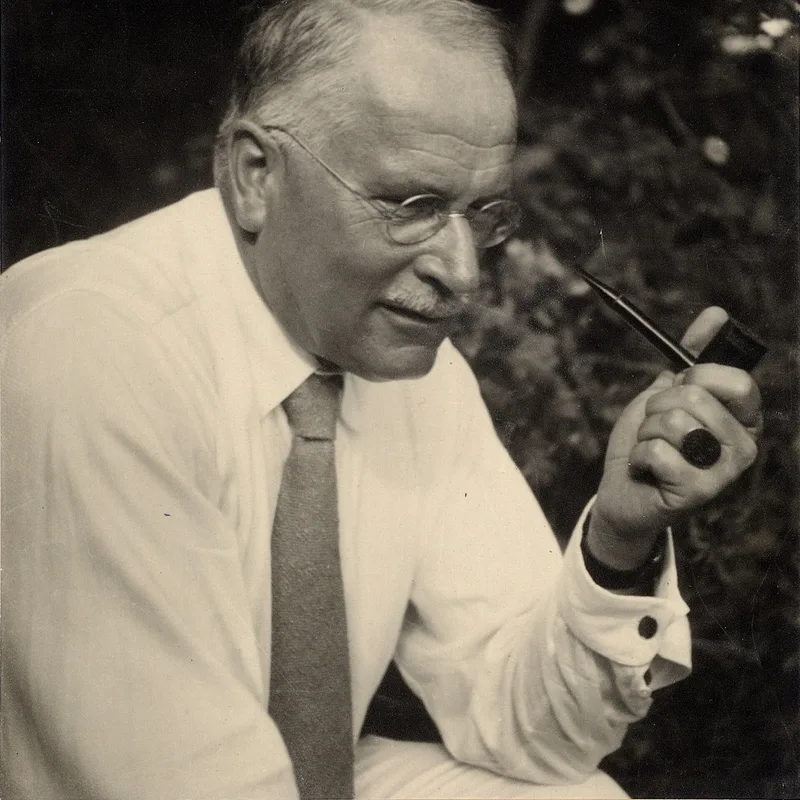
Carl Jung
Psychiatrist, Analytical psychologist, 1875–1961
Empiricist of the psyche
What is the meaning of life?
To kindle a light in the darkness of mere being.
Jung's answer rests on consciousness. In Memories, Dreams, Reflections, dictated in his eighties, he wrote that a person's task is to become conscious of what presses up from the unconscious, and that as far as we can tell the sole purpose of human existence is to kindle a light in the darkness of mere being. He added a test: whether a person is related to something infinite, because only then does a life escape being spent on futilities. The view grew out of his practice; in Modern Man in Search of a Soul (1933) he reported that every patient over thirty-five had, at bottom, the problem of finding a religious outlook on life. What that meaning contains he left to each person, since there is no recipe for living that suits all cases.
-
“As far as we can discern, the sole purpose of human existence is to kindle a light in the darkness of mere being.”1
-
“The decisive question for man is: Is he related to something infinite or not? That is the telling question of his life.”2
-
“But one thing you must know, the one thing I have learned is that one must live this life. This life is the way, the long sought-after way to the unfathomable, which we call "divine". There is no other way. All other ways are false paths.”3
-
“For it all depends on how we look at things, and not on how they are in themselves. The least of things with a meaning is worth more in life than the greatest of things without it.”4
What is the meaning of the universe?
Creation completed by consciousness; God known, not believed.
Jung treated God as a psychic fact he had met rather than a doctrine he accepted. Asked on the BBC programme Face to Face in 1959 whether he believed in God, he paused and said he did not need to believe — he knew. He gave the psyche the rank of a cosmic principle: without a consciousness to reflect it there is, practically speaking, no world. On the Athi Plains in Kenya in 1925 this came to him as a revelation, and he described man as the second creator, who gives the world its objective existence. Behind the psychic veil, he held, stands an uncomprehended absolute object; in a 1958 letter he put it that there is as little doubt of a supreme being as of matter, and we understand neither.
-
“Difficult to answer. I know. I don't need to believe. I know.”5
-
“Nevertheless, we have good reason to suppose that behind this veil there exists the uncomprehended absolute object which affects and influences us—and to suppose it even, or particularly, in the case of psychic phenomena about which no verifiable statements can be made.”6
-
“Without consciousness there would, practically speaking, be no world, for the world exists as such only in so far as it is consciously reflected and considered by a psyche. Consciousness is a precondition of being.”7
-
“We know as little of a supreme being as of Matter. But there is as little doubt of the existence of a supreme being as of Matter. The world beyond is reality, and experiential fact. We only don't understand it.”8