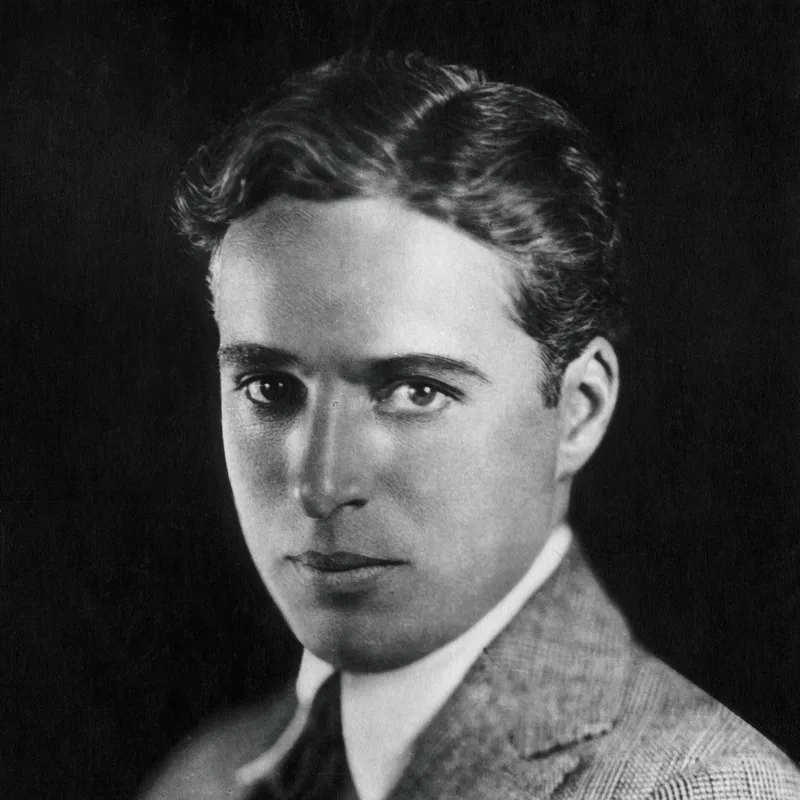
Charlie Chaplin
Comic actor, Filmmaker, 1889–1977
Agnostic
What is the meaning of life?
Beauty, when you can find it; happiness is an end in itself.
Chaplin did not set out a philosophy of life, but in interviews of the 1920s he kept coming back to beauty and happiness. Quoted by the San Francisco Call in 1922, he said that people miss happiness by chasing false values, and that the minutes of reacting happily to life on a good morning are an end in themselves. In a 1925 interview he said he liked tragedy better than comedy because it is beautiful, and that beauty is all there is in life, though it is hard to find; asked in the same interview whether life was worth while, he answered "at times", and gave lying on a beach in empty bliss as his example. In My Autobiography (1964), published when he was seventy-five, he disagreed with Schopenhauer that happiness is a negative state: in twenty years of marriage to Oona O'Neill, he wrote, he had known what happiness means.
-
“People miss happiness by chasing after false values and repressing the feelings that make life valuable and beautiful. When you get up in the morning feeling fine your experience during just those few minutes or hours when you are reacting happily to life is an end in itself.”1
-
“I like tragedy; it is beautiful. The only comedy that is worth while is when it has beauty. That is all there is in life—beauty. You find that and you have found everything. Only it is hard to find.”2
-
“Schopenhauer said happiness is a negative state — but I disagree. For the last twenty years I have known what happiness means. I have the good fortune to be married to a wonderful wife.”3
What is the meaning of the universe?
No dogma, but faith in the unknown and its power for good.
Chaplin grew up in poverty in London with a mother who read him the New Testament; he wrote that she gave the most luminous interpretation of Christ he had ever heard. As an adult he was not religious in the dogmatic sense. At a dinner with Rachmaninoff he confessed that he was not a believer, explaining that for him religion meant belief in a dogma. In My Autobiography (1964) he said he neither believed nor disbelieved, and that reason cannot always reach the truth; he put his faith in the unknown, would not accept that existence is meaningless or accidental, as some scientists said, and believed that in the realm of the unknown there is an infinite power for good. His funeral in 1977 was a small, private Anglican service, according to his wishes.
-
“I neither believe nor disbelieve in anything. That which can be imagined is as much an approximation to truth as that which can be proved by mathematics. One cannot always approach truth through reason; it confines us to a geometric cast of thought that calls for logic and credibility.”4
-
“My faith is in the unknown, in all that we do not understand by reason; I believe that what is beyond our comprehension is a simple fact in other dimensions, and that in the realm of the unknown there is an infinite power for good.”5
-
“In such bewilderment of grief it is futile to seek an answer. It only leads to false moralizing and torment – yet it does not mean that there is no answer. I cannot believe that our existence is meaningless or accidental, as some scientists would tell us. Life and death are too resolute, too implacable to be accidental.”6