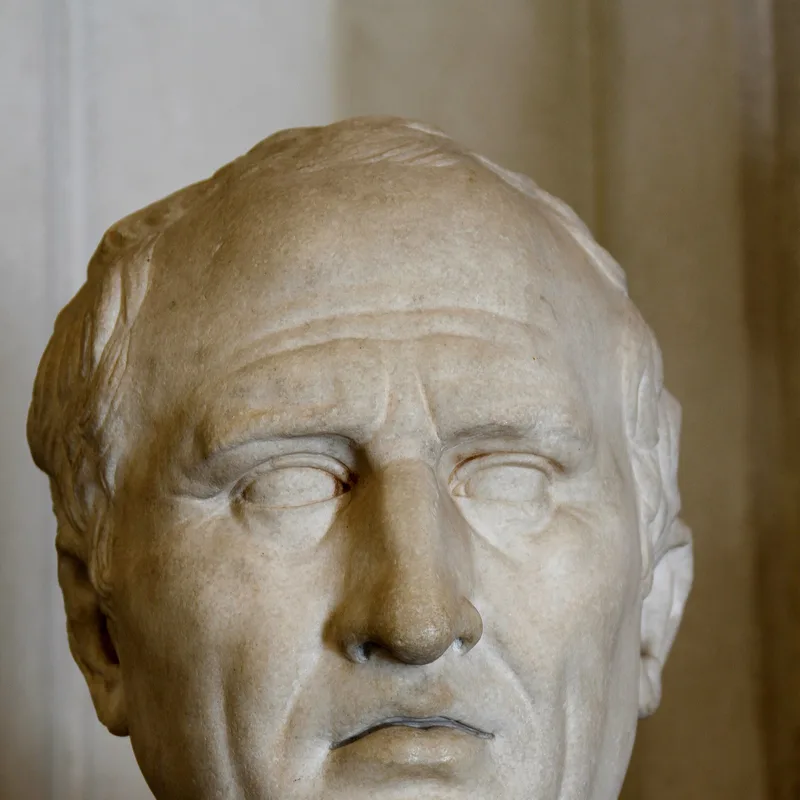
Cicero
Statesman, Orator, Philosopher, 106–43 BC
Academic skeptic, leaning Stoic
What is the meaning of life?
Virtue alone is enough for a happy life.
Cicero was Rome's greatest orator, a consul who suppressed the conspiracy of Catiline, and the man who brought Greek philosophy into Latin. Most of his philosophical works were written in a burst in 45–44 BC, after the death of his daughter Tullia and while Caesar's dictatorship kept him out of politics. In the Tusculan Disputations he argued, against all the blows of fortune, that virtue alone is sufficient for a happy life. He was murdered in 43 BC on the orders of Mark Antony, whom he had attacked in his last speeches.
-
“…virtue is of itself sufficient for a happy life: and though it may be difficult to prove this, on account of the many various strokes of fortune, yet it is a truth of such a nature that we should endeavor to facilitate the proof of it.”1
What is the meaning of the universe?
A providential divine order is the more probable view.
As a philosopher Cicero belonged to the Academic school, which held that certainty is out of reach and that one should follow what is most probable. In On the Nature of the Gods (45 BC) he set an Epicurean, a Stoic and an Academic sceptic against one another on whether the gods exist and care for the world. At the end he gave his own verdict: the sceptic's arguments convinced his Epicurean friend, but the Stoic case for a divine reason that orders and governs the world seemed to him the more probable.
-
“The conversation ended here, and we parted. Velleius judged that the arguments of Cotta were truest; but those of Balbus seemed to me to have the greater probability.”2