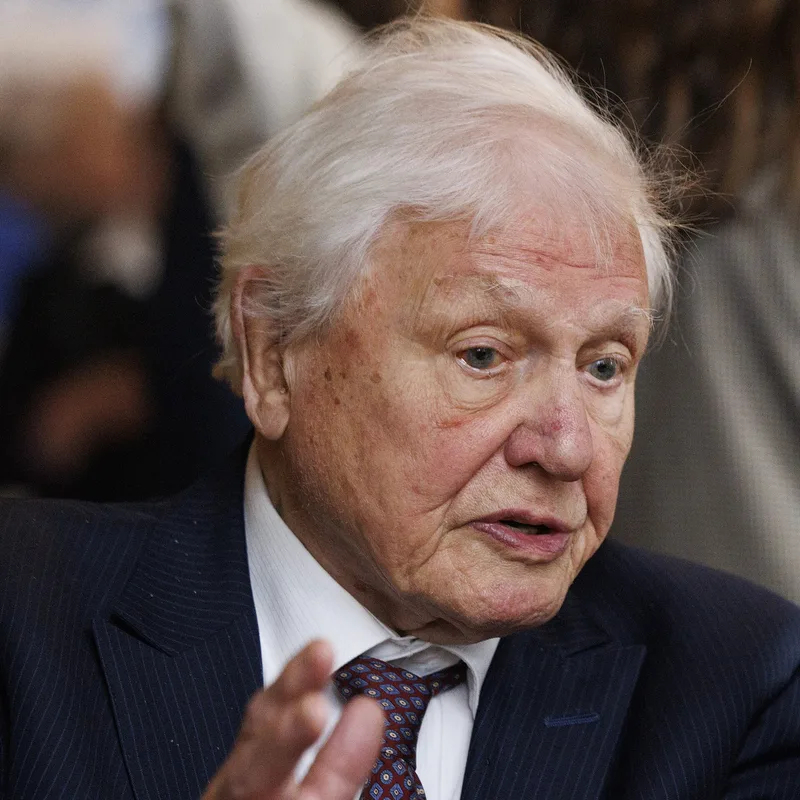
David Attenborough
Broadcaster, Naturalist, born 1926
Agnostic
What is the meaning of life?
To be wanted, to keep working, and to take comfort in nature.
Attenborough has not set out a philosophy of life; what he has said about it comes from his work and from loss. His wife, Jane, died suddenly in 1997, after nearly fifty years of marriage. At 85, while making Frozen Planet, he told Ginny Dougary of the Radio Times that in deep grief the only consolation to be found is in the natural world, because we are part of it and part of a big, enduring thing. In the same interview he said it would be awful to get up in the morning with nobody wanting you to do anything, and that merely filling in the time was not what he was about.
-
“In moments of grief – deep grief – the only consolation you can find is in the natural world. People write to me and tell me this. People of great distinction (I won’t name names) have written and said, ‘When so-and-so died, the only thing that made life tolerable was to watch programmes on plants and animals.’ And I thought, ‘That’s true for me, yes.’ Because we are part of it and part of a big, enduring thing.”1
-
“It seems to me to be absolutely awful to be getting up in the morning and nobody wanting you to do anything. You have to have someone who goes … ‘WHY ISN’T BLOODY ATTENBOROUGH THERE?’ – and then you have a reason to get up at four o’clock in the morning because you know you’re wanted. But just to be filling in the time, like playing golf (which I’ve never done in my life), is not what I’m about.”2
What is the meaning of the universe?
Unknown; evolution leaves room for God, if not a merciful designer.
Attenborough's parents did not bring him up with religious beliefs, and he has said it never really occurred to him to believe in God; he calls himself an agnostic. Asked on CBS's 60 Minutes, while filming in Mali at 75, whether he had an answer to why we are here, he said he did not know, and told the story he has repeated in many interviews to people who cite hummingbirds and butterflies as proof of creation: a boy in West Africa going blind from a parasitic worm, which a creator God would also have made. He finds that hard to accommodate, he said, and prefers to show the facts and let viewers draw their own conclusions. On Desert Island Discs in 2012 he said that accepting the four-billion-year history of life is not inconsistent with belief in a supreme being, and that he was not confident enough to call himself an atheist.
-
“I don't know. People sometimes say to me why don't you admit that the humming bird and the butterfly and the Bird of Paradise are proof of the wonderful things produced by creation. And I always say, 'Well, when you say that you've also got to think of a little boy sitting on a riverbank like here in West Africa that's got a little worm, a living organism, that's in its eye and boring through its eyeballs and is slowly turning it blind. The creator God that you believe in presumably also made that little worm.'”3
-
“Now I personally find that difficult to accommodate and so therefore when I make these films I prefer to show what I know to be the facts. What I know to be true. And then people can deduce what they will from that.”4
-
“I don't think an understanding and an acceptance of the 4 billion-year-long history of life is any way inconsistent with a belief in a supreme being. And I am not so confident as to say that I am an atheist.”5