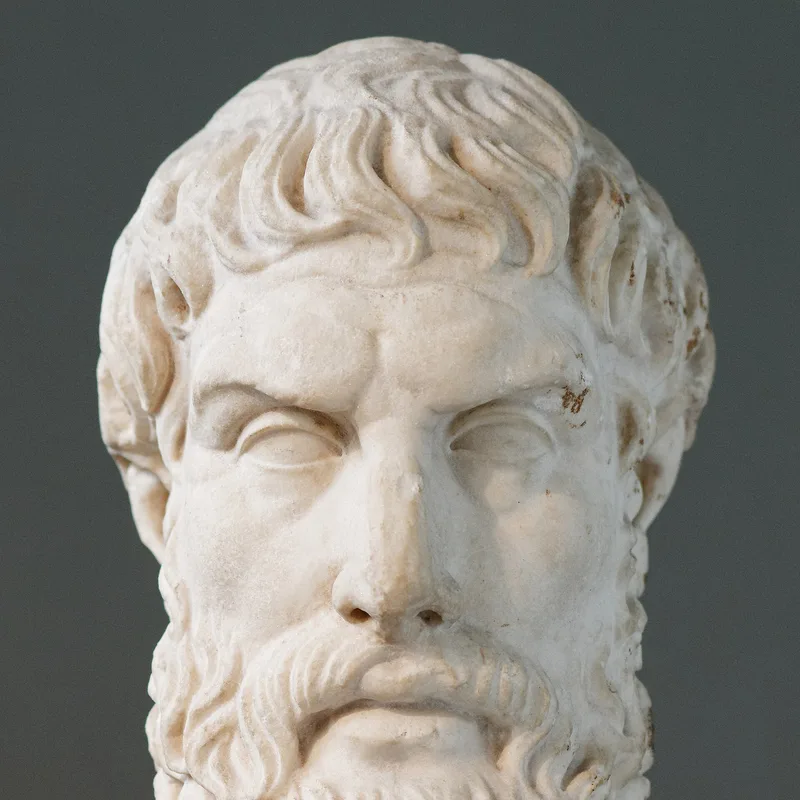
Epicurus
Philosopher, 341–270 BC
Atomist
What is the meaning of life?
Pleasure: no pain in the body, no trouble in the soul.
Epicurus opened his school, the Garden, in Athens around 306 BC and taught that the goal of life is pleasure. By pleasure he meant the absence of pain in the body and of disturbance in the mind, not feasting and sex; bread, water and friends were enough. Most of his books are lost, and the ethics survives mainly in the Letter to Menoeceus and the Principal Doctrines, preserved by Diogenes Laertius. The method is to sort desires into the natural and necessary, the natural but unnecessary, and the empty, and to remove the two great fears, of the gods and of death — which is nothing to us, because where it is, we are not. Prudence, honour and justice are not rivals to pleasure but the conditions of it.
-
“When we say, then, that pleasure is the end and aim, we do not mean the pleasures of the prodigal or the pleasures of sensuality, as we are understood to do by some through ignorance, prejudice, or wilful misrepresentation. By pleasure we mean the absence of pain in the body and of trouble in the soul.”1
-
“For the end of all our actions is to be free from pain and fear, and, when once we have attained all this, the tempest of the soul is laid; seeing that the living creature has no need to go in search of something that is lacking, nor to look for anything else by which the good of the soul and of the body will be fulfilled.”1
-
“It is impossible to live a pleasant life without living wisely and honorably and justly, and it is impossible to live wisely and honorably and justly without living pleasantly.”2
-
“Death, therefore, the most awful of evils, is nothing to us, seeing that, when we are, death is not come, and, when death is come, we are not.”3
What is the meaning of the universe?
Atoms and void, endless worlds; the gods take no interest.
Epicurus took his physics from Democritus: all that exists is bodies and empty space, and bodies are built from indivisible atoms that have moved through the void forever. Nothing comes from nothing, the sum of things is infinite and has always been as it is, and there are countless worlds, ours one of them, formed and dissolved as atoms collide. The gods exist, though not as the many imagine them — the impious man, he wrote, is the one who pins popular beliefs on them — and they are blessed, untroubled beings who neither made the world nor run it, so eclipses and seasons happen without any divine command. The soul is atoms too and scatters at death. The riddle "Is God willing to prevent evil, but not able?" is reported centuries later by the Christian writer Lactantius and is not in his surviving writings.
-
“Further, the whole of being consists of bodies and space. … Beyond bodies and space there is nothing which by mental apprehension or on its analogy we can conceive to exist.”4
-
“Of all this there is no beginning, since both atoms and void exist from everlasting. … Moreover, there is an infinite number of worlds, some like this world, others unlike it.”4
-
“For verily there are gods, and the knowledge of them is manifest; but they are not such as the multitude believe, seeing that men do not steadfastly maintain the notions they form respecting them. Not the man who denies the gods worshipped by the multitude, but he who affirms of the gods what the multitude believes about them is truly impious.”1
-
“A happy and eternal being has no trouble himself and brings no trouble upon any other being; hence he is exempt from movements of anger and partiality, for every such movement implies weakness.”5