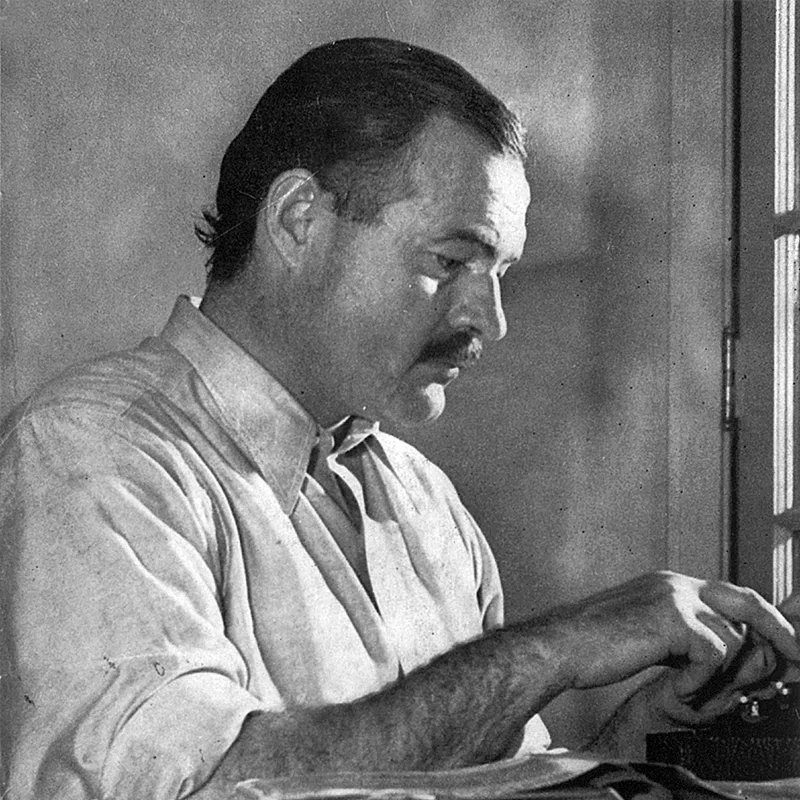
Ernest Hemingway
Novelist, Short-story writer, Journalist, 1899–1961
Catholic convert
What is the meaning of life?
To last, get your work done, and see, hear, learn, understand.
Hemingway answered through work and attention rather than doctrine. In Death in the Afternoon (1932), his non-fiction book on Spanish bullfighting, he wrote that the great thing is to last and get your work done, and to see, hear, learn and understand; time, he added there, is all we have, and the simplest things take a lifetime to learn. In Green Hills of Africa (1935) he said he had a good life but had to write, or he could not enjoy the rest of it. In the Paris Review interview of 1958 he described what the writing was for: out of everything he knew he made something new, truer than anything true, and if he made it well enough he gave it immortality.
-
“The great thing is to last and get your work done and see and hear and learn and understand; and write when there is something that you know; and not before; and not too damned much after.”1
-
“There are some things which cannot be learned quickly, and time, which is all we have, must be paid heavily for their acquiring. They are the very simplest things and because it takes a man's life to know them the little new that each man gets from life is very costly and the only heritage he has to leave.”2
-
“From things that have happened and from things as they exist and from all things that you know and all those you cannot know, you make something through your invention that is not a representation but a whole new thing truer than anything true and alive, and you make it alive, and if you make it well enough, you give it immortality. That is why you write and for no other reason that you know of.”3
What is the meaning of the universe?
More faith than knowledge; facing eternity, or the lack of it.
Hemingway grew up in a Protestant family in Oak Park, Illinois, and became a Catholic formally before marrying Pauline Pfeiffer in 1927; he traced his faith back to 1918, when he was badly wounded in Italy as a Red Cross ambulance driver and anointed by a priest. In an unsent letter to a priest in 1927 he called himself a very dumb Catholic with more faith than intelligence or knowledge, and said he never wanted to be known as a Catholic writer. He went to Mass irregularly for the rest of his life, and came to believe that his divorces barred him from full communion. In the speech read for him at the 1954 Nobel banquet he said that a good writer must face eternity, or the lack of it, each day; in Death in the Afternoon he had written that every story, continued far enough, ends in death.
-
“I have always had more faith than intelligence or knowledge and I have never wanted to be known as a Catholic writer because I know the importance of setting an example — and I have never set a good example.”4
-
“For he does his work alone and if he is a good enough writer he must face eternity, or the lack of it, each day.”5
-
“Madame, all stories, if continued far enough, end in death, and he is no true-story teller who would keep that from you.”6