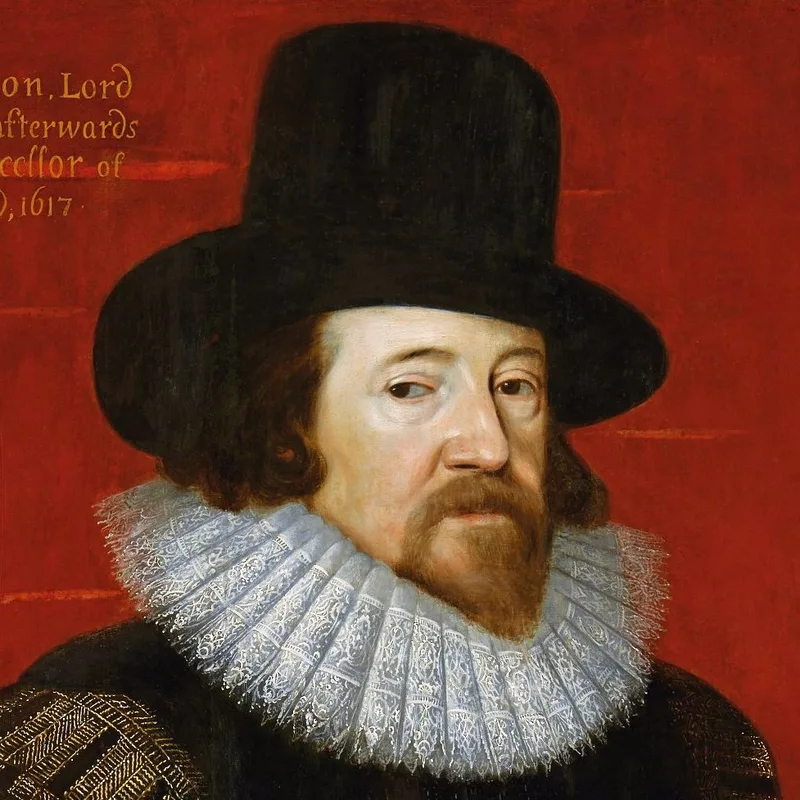
Francis Bacon
Philosopher, Statesman, Essayist, 1561–1626
Anglican, father of empiricism
What is the meaning of life?
Seek knowledge for God's glory and the relief of human life.
Bacon was a lawyer and courtier who rose to be Lord Chancellor of England before his fall for taking bribes in 1621, and a philosopher who argued that knowledge should be built on careful observation and experiment rather than on ancient authority. He thought most people sought learning for the wrong reasons: curiosity, reputation, winning arguments or profit. Its true end was to be a storehouse for the glory of the Creator and the relief of man's estate, the improvement of human life. Of all virtues, he wrote, goodness, the care for the welfare of others, is the greatest.
-
“…as if there were sought in knowledge a couch whereupon to rest a searching and restless spirit; or a terrace for a wandering and variable mind to walk up and down with a fair prospect; or a tower of state, for a proud mind to raise itself upon; or a fort or commanding ground, for strife and contention; or a shop, for profit or sale; and not a rich storehouse for the glory of the Creator and the relief of man’s estate.”1
-
“I take goodness in this sense, the affecting of the weal of men, which is that the Grecians call philanthropia… This of all virtues, and dignities of the mind, is the greatest; being the character of the Deity: and without it, man is a busy, mischievous, wretched thing; no better than a kind of vermin.”2
What is the meaning of the universe?
A little philosophy leads to atheism; depth in philosophy leads to God.
Bacon wanted natural science freed from theology so that each could do its own work, but he did not think science led away from God. In his essay “Of Atheism” he argued that a shallow look at nature sees only scattered causes and may stop there, while a deeper look sees how the causes are linked in a chain, and that chain leads the mind to providence and God. He held that God has given us two books to study, Scripture and the book of nature, and that reading the second is a way of honouring the first.
-
“It is true, that a little philosophy inclineth man's mind to atheism; but depth in philosophy bringeth men's minds about to religion. For while the mind of man looketh upon second causes scattered, it may sometimes rest in them, and go no further; but when it beholdeth the chain of them, confederate and linked together, it must needs fly to Providence and Deity.”3