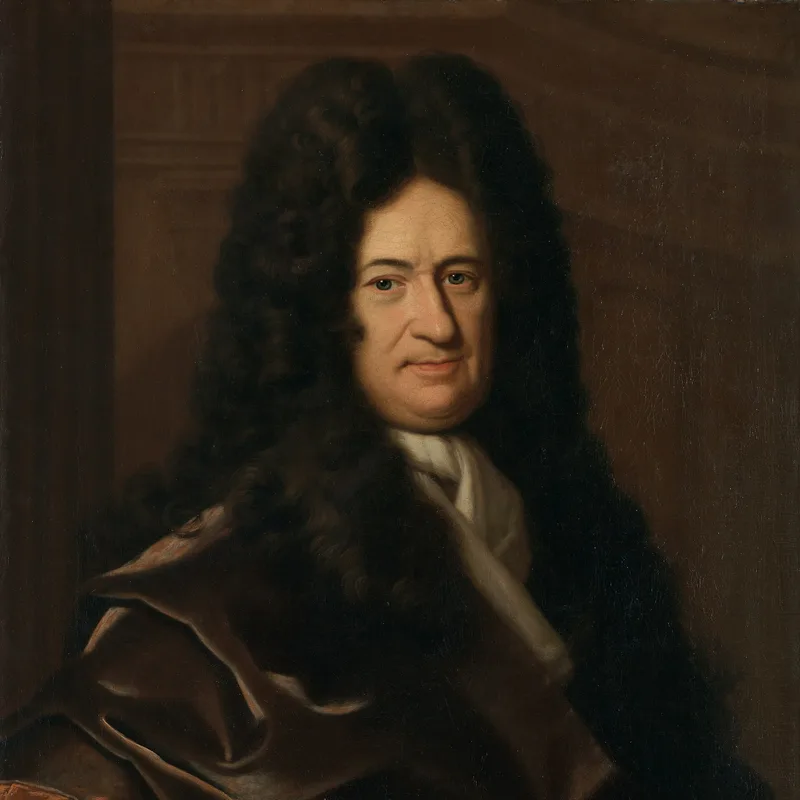
Gottfried Wilhelm Leibniz
Philosopher, Mathematician, Diplomat, 1646–1716
Rationalist theist
What is the meaning of life?
To love: to delight in another's happiness, and work for all.
Leibniz was a court counsellor, librarian and diplomat who invented the calculus independently of Newton and built a calculating machine, and he saw all of it as serving one end. In his definitions happiness and love belong together: to love is to take pleasure in another's happiness, and justice is charity guided by wisdom. The love of God, he wrote in 1677, shows itself as an ardent desire to work for the general welfare, to which the perfection of reason contributes more than anything. His many projects, from learned academies and a universal language to the reunion of the churches, were meant as work of that kind.
What is the meaning of the universe?
God chose the best of all possible worlds.
Leibniz asked why there is something rather than nothing, and answered with God, the necessary being who holds the reason for everything else. Before creating, God surveyed an infinity of possible worlds and, being perfectly good and wise, chose the best: not a world without evil, but the one in which the whole is most perfect, simplest in its laws and richest in its phenomena. He defended this view in the Theodicy (1710), the only philosophical book he published in his lifetime. Voltaire mocked it in Candide, and the best of all possible worlds has been quoted ironically ever since.