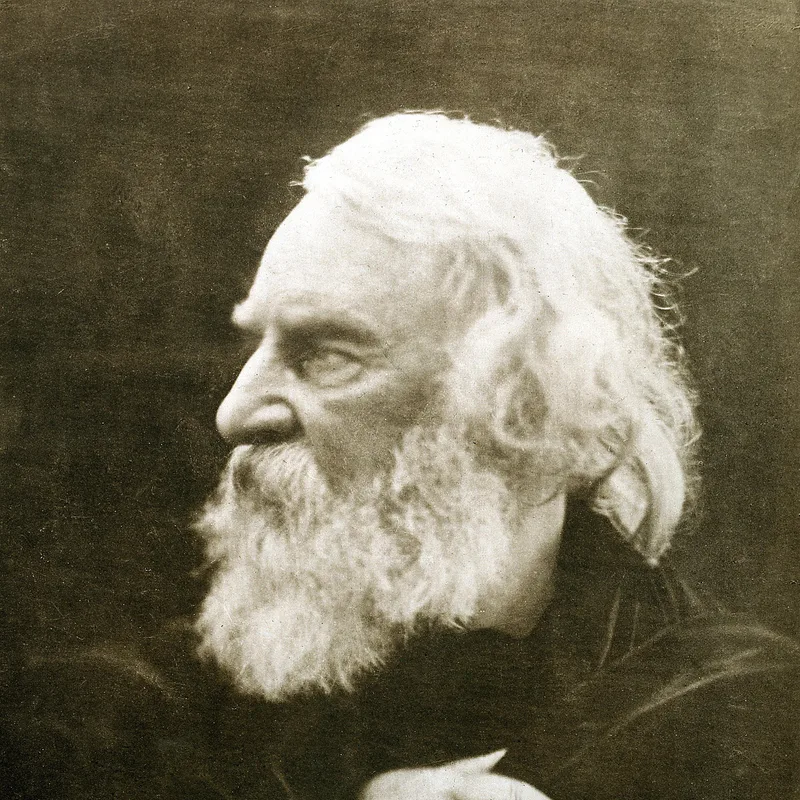
Henry Wadsworth Longfellow
Poet, Professor, 1807–1882
Unitarian Christian
What is the meaning of life?
Life is real and earnest: act in the living present.
Longfellow was the most popular American poet of the nineteenth century, a Harvard professor of modern languages who translated Dante and wrote The Song of Hiawatha, Evangeline and “Paul Revere's Ride”. “A Psalm of Life” (1838), written while he was still grieving his first wife, who had died after a miscarriage, answers despair with action: life is real and earnest, the dead past should bury its dead, and the task is to act in the living present. The lives of great men show that ordinary lives too can be made sublime; the poem ends by urging its readers to be up and doing, with a heart for any fate.
What is the meaning of the universe?
The grave is not the goal; the soul is not dust.
Longfellow was a Unitarian, brought up in a liberal New England Christianity that stressed God's goodness and the soul's immortality rather than sin and damnation. His poems keep returning to death, of his first wife and later of his second, who burned to death in 1861, but they treat the grave as a passage rather than an end: “dust thou art, to dust returnest” was not spoken of the soul. Over the whole of life stands, in the poem's phrase, God o'erhead.