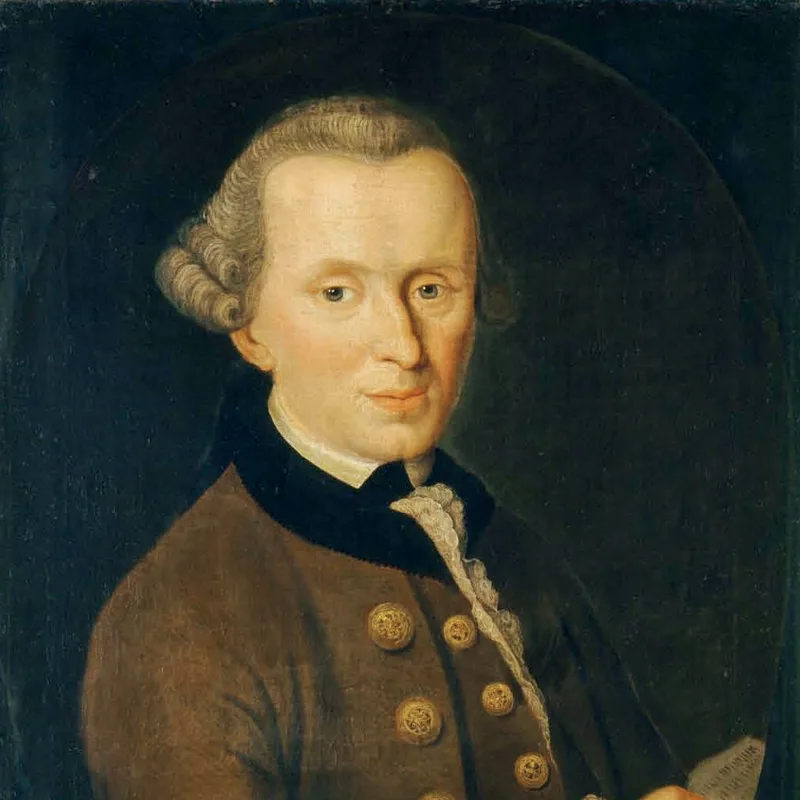
Immanuel Kant
Philosopher, 1724–1804
Moral theist
What is the meaning of life?
Act from duty, treat each person as an end, deserve happiness.
Kant's answer to how to live is in the Groundwork of the Metaphysics of Morals (1785) and the Critique of Practical Reason (1788). The only thing good without qualification is a good will, and a will is good when it acts from duty under a law it gives itself: act only on a maxim you could will to be a universal law, and treat humanity, in yourself and in others, always as an end and never merely as a means. Morality is not a recipe for being happy but for becoming worthy of happiness. The complete good — virtue joined to the happiness it deserves — cannot be guaranteed in this world, so practical reason has to postulate freedom, an immortal soul and God to make it possible. In the first Critique he gathered all of reason's interests into three questions: what can I know, what ought I to do, what may I hope.
-
“Nothing can possibly be conceived in the world, or even out of it, which can be called good, without qualification, except a good will.”1
-
“So act as to treat humanity, whether in thine own person or in that of any other, in every case as an end withal, never as means only.”1
-
“Hence also morality is not properly the doctrine how we should make ourselves happy, but how we should become worthy of happiness.”2
-
“The whole interest of reason, speculative as well as practical, is centred in the three following questions: 1. What can I know? 2. What ought I to do? 3. What may I hope?”3
What is the meaning of the universe?
Beyond appearances we cannot know; God is a matter of moral faith.
In the Critique of Pure Reason (1781) Kant argued that we know only appearances, things as they are shaped by our own forms of space and time and by the categories of the understanding; things in themselves, and with them God, freedom and immortality, lie beyond possible knowledge. The traditional proofs of God's existence all fail, but so do the disproofs, and he said he had to deny knowledge to make room for faith. That faith is moral: the moral law commands us to pursue the highest good, which is possible only if there is a God, so it is morally necessary to assume one. As a young man he had proposed that the solar system condensed from a cloud of matter under Newton's laws, and the conclusion of the second Critique puts the two sides of his thought together: the starry heavens, which make a human being a speck, and the moral law within, which gives him a worth beyond the whole sensible world.
-
“Two things fill the mind with ever new and increasing admiration and awe, the oftener and the more steadily we reflect on them: the starry heavens above and the moral law within.”4
-
“I must, therefore, abolish knowledge, to make room for belief.”5
-
“As this is possible only on condition of the existence of God, it inseparably connects the supposition of this with duty; that is, it is morally necessary to assume the existence of God.”2
-
“I must not even say: It is morally certain that there is a God, etc., but: I am morally certain, that is, my belief in God and in another world is so interwoven with my moral nature that I am under as little apprehension of having the former torn from me as of losing the latter.”6