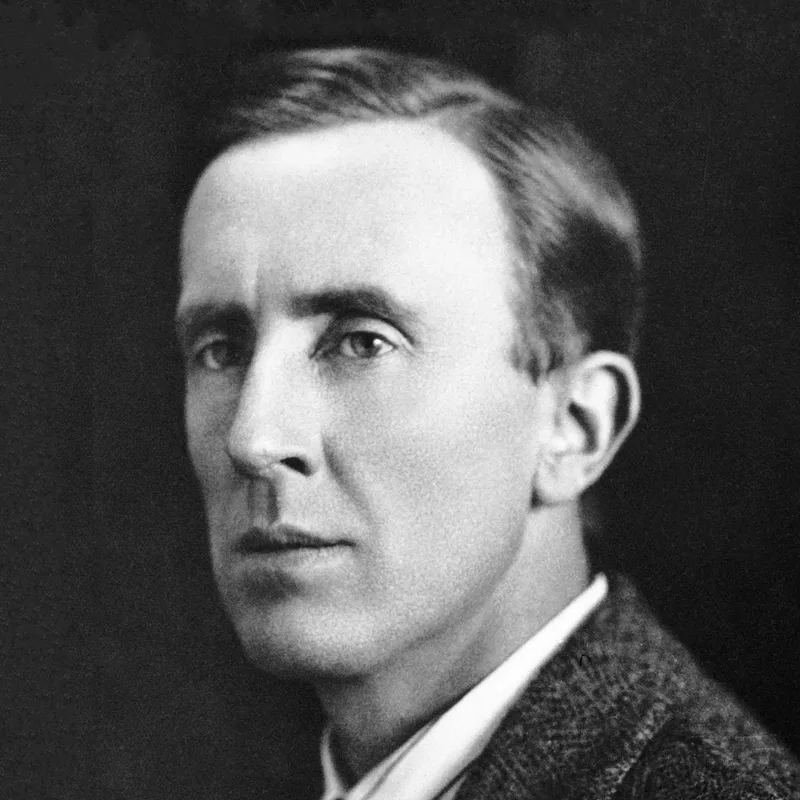
J. R. R. Tolkien
Novelist, Philologist, 1892–1973
Roman Catholic
What is the meaning of life?
To know God ever better, and be moved to praise and thanks.
In 1969 Camilla Unwin, the daughter of his publisher Rayner Unwin, was set a school project and wrote to ask Tolkien what the purpose of life is. He answered that without belief in a personal God the question cannot be asked or answered, and that the chief purpose of life is to know God better by every means we have, and to be moved by that knowledge to praise and thanks. He saw story-making in the same light: in the poem "Mythopoeia" (1931) people still make "by the law in which we're made", and in the lecture "On Fairy-Stories" (1939) he called the storyteller a sub-creator who may help enrich creation. To his son Michael in 1941 he named the Blessed Sacrament the one great thing to love on earth.
-
“If you do not believe in a personal God, the question: 'What is the purpose of life?' is unaskable and unanswerable.”1
-
“So it may be said that the chief purpose of life, for any one of us, is to increase according to our capacity our knowledge of God by all the means we have, and to be moved by it to praise and thanks.”2
-
“Though all the crannies of the world we filled with elves and goblins, though we dared to build gods and their houses out of dark and light, and sow the seeds of dragons, 'twas our right (used or misused). The right has not decayed. We make still by the law in which we're made.”3
-
“Out of the darkness of my life, so much frustrated, I put before you the one great thing to love on earth: the Blessed Sacrament … There you will find romance, glory, honour, fidelity, and the true way of all your loves upon earth.”4
What is the meaning of the universe?
A personal Creator; in the Gospels, legend and history have fused.
Tolkien was a devout Roman Catholic from childhood. His mother was received into the Catholic Church in 1900 despite her Baptist family's protests and died in 1904, when he was twelve; Father Francis Morgan of the Birmingham Oratory then brought him and his brother up in the faith. He believed in a personal Creator and held that human myth-making draws its wisdom from him: "Mythopoeia" answered a night-time argument in 1931 with C. S. Lewis, who then called myths lies breathed through silver, and Tolkien was a significant factor in Lewis's conversion from atheism. In "On Fairy-Stories" he argued that the Gospels contain a fairy-story that has entered history and is true. In a 1953 letter he called The Lord of the Rings "a fundamentally religious and Catholic work", its religion absorbed into the story rather than named.
-
“The Gospels contain a fairy-story, or a story of a larger kind which embraces all the essence of fairy-stories. … But this story has entered History and the primary world … this story is supreme; and it is true. Art has been verified. God is the Lord, of angels, and of men — and of elves. Legend and History have met and fused.”5
-
“The heart of man is not compound of lies, but draws some wisdom from the only Wise, and still recalls him. Though now long estranged, man is not wholly lost nor wholly changed.”3