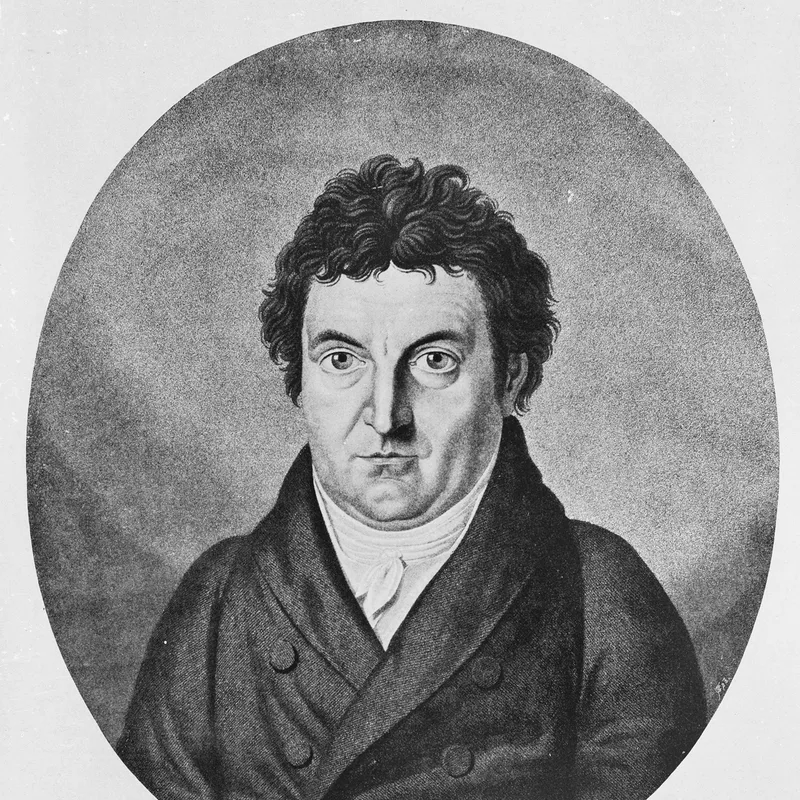
Johann Gottlieb Fichte
Philosopher, 1762–1814
Idealist, God as moral order
What is the meaning of life?
Obeying the voice of conscience is the business of my existence.
Fichte was the son of a poor ribbon weaver in Saxony; a local nobleman who heard the boy repeat a sermon from memory paid for his education. An admirer of Kant, he became famous almost overnight when his first book, published anonymously, was mistaken for Kant's own, and he went on to found German idealism, a philosophy that starts from the free, acting self. In The Vocation of Man (1800) he described his way out of doubt: knowledge alone cannot tell us what we are for, but the voice of conscience can, and to listen to it and obey it honestly and without fear is the business of one's existence. Humanity, he had told students at Jena, can bear the loss of everything but the possibility of improvement.
-
“The voice in my soul in which I will have faith, and for the sake of which I have faith in all else, does not merely command me generally to act, but in every particular situation it declares what I shall do and what leave undone; it accompanies me through every event of my life, and it is impossible for me to contend against it. To listen to it and obey it honestly and impartially, without fear or equivocation, is the business of my existence.”1
-
“Humanity may endure the loss of everything: all its possessions may be torn away without infringing its true dignity; — all but the possibility of improvement.”2
What is the meaning of the universe?
I veil my face before the Infinite, which I can never comprehend.
In 1798 Fichte published an essay identifying God with the moral order of the world and was accused of atheism; the scandal cost him his professorship at Jena. His answer, in The Vocation of Man, was not a return to the personal God of the churches but a hymn to an infinite Will that works through conscience and binds all free beings together. He addressed that Will directly, and confessed that it lay beyond all understanding: whatever he could comprehend would become finite in being comprehended, and after a thousand lives he would understand it no better than now.
-
“I veil my face before thee, and lay my finger on my lips. What thou art in thyself, or how thou appearest to thyself, I can never know. After living through a thousand lives, I shall comprehend Thee as little as I do now in this mansion of clay. What I can comprehend, becomes finite by my mere comprehension, and this can never, by perpetual ascent, be transformed into the infinite…”1