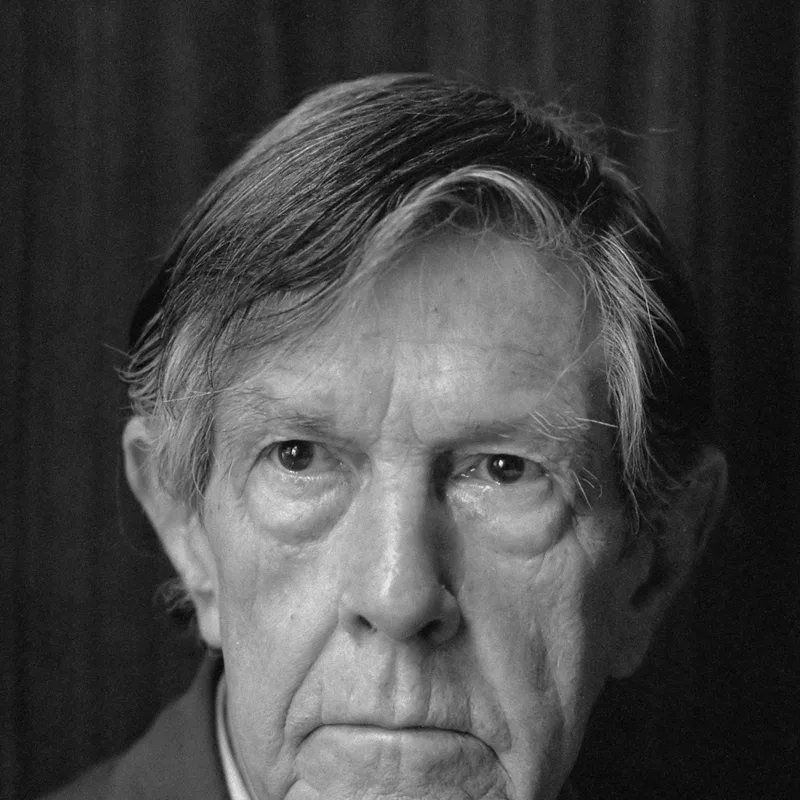
John Cage
Composer, Writer, 1912–1992
Zen-influenced
What is the meaning of life?
Purposeless play: waking up to the very life we're living.
In the mid-1940s Cage lost faith in music as a way of communicating and nearly stopped composing. The answer he kept came from the Indian musician Gita Sarabhai: the purpose of music is to sober and quiet the mind, making it open to divine influences. Through D. T. Suzuki's classes on Zen at Columbia he widened this into a view of life. In the 1957 lecture "Experimental Music" he called the purpose a paradox, purposeless play: not an effort to improve creation, but a way of waking up to the life we already have once our desires get out of the way. Late in life he said our proper business is curiosity and awareness, and that value judgments get in its way.
-
“I remember loving sound before I ever took a music lesson. And so we make our lives by what we love.”1
-
“This play, however, is an affirmation of life—not an attempt to bring order out of chaos nor to suggest improvements in creation, but simply a way of waking up to the very life we're living, which is so excellent once one gets one's mind and one's desires out of its way and lets it act of its own accord.”2
-
“Value judgments are destructive to our proper business, which is curiosity and awareness.”3
What is the meaning of the universe?
The world is not an object but a process.
Cage's picture of reality came from Asian thought: the Huang-Po Doctrine of Universal Mind, the Ten Oxherding Pictures, and Neti Neti, "not this, not this", a book he said his life could illustrate. From 1951 he composed by I Ching chance operations, following Ananda Coomaraswamy's idea that the artist should imitate nature in her manner of operation rather than impose a design. Reality, for him, was change itself: in conversations with Daniel Charles he said the world is not a thing standing there but a process. He credited Zen for what he did while refusing to blame his work on it, and never practised sitting meditation.
-
“You say: the real, the world as it is. But it is not, it becomes! It moves, it changes! It doesn't wait for us to change … The world, the real is not an object. It is a process.”4
-
“What I do, I do not wish blamed on Zen, though without my engagement with Zen … I doubt whether I would have done what I have done.”5
-
“Ramakrishna it was who said all religions are the same, like a lake to which people who are thirsty come from different directions, calling its water by different names.”6