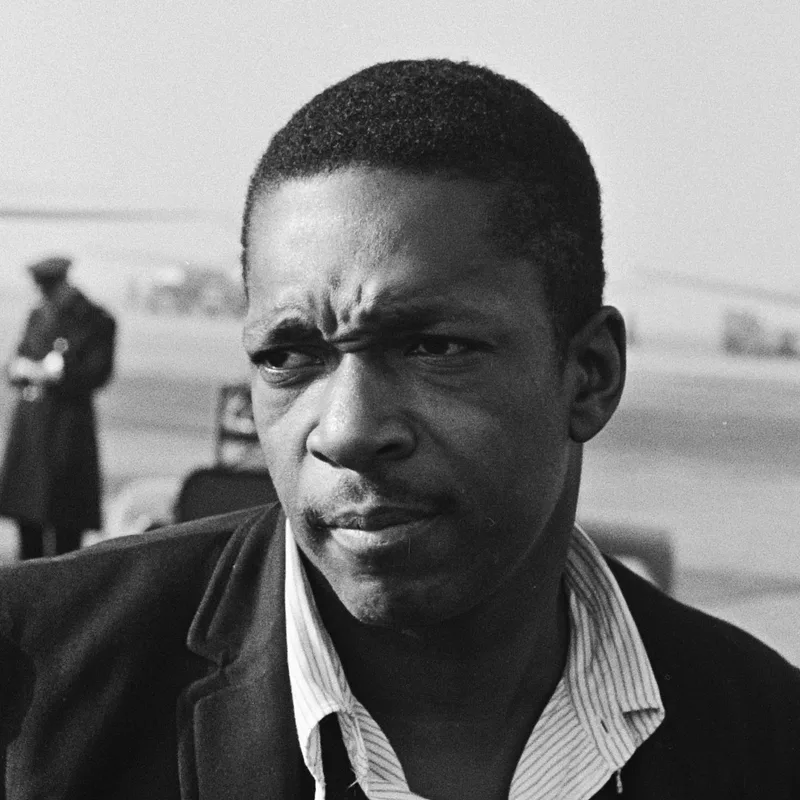
John Coltrane
Saxophonist, Composer, 1926–1967
Universalist
What is the meaning of life?
To live a truly religious life and uplift people through music.
Coltrane dated his answer to 1957, the year he quit heroin and alcohol. In the liner notes to A Love Supreme (1965) he called it a spiritual awakening by the grace of God, after which he asked to be given the means to make others happy through music. From then on the music and the religious life were one project. He told Newsweek in 1966 that his goal was to live a truly religious life and express it in his music, and in the notes to Meditations that his aim was to uplift people and help them realise their capacity for meaningful lives — because, he added, there certainly is meaning to life. Asked in Tokyo what he wanted to be in ten years, he answered: a saint.
-
“During the year 1957, I experienced, by the grace of God, a spiritual awakening which was to lead me to a richer, fuller, more productive life. At that time, in gratitude, I humbly asked to be given the means and privilege to make others happy through music.”1
-
“Once you become aware of this force for unity in life, you can't ever forget it. It becomes part of everything you do. … My goal in meditating on this through music, however, remains the same. And that is to uplift people, as much as I can. To inspire them to realize more and more of their capacities for living meaningful lives. Because there certainly is meaning to life.”2
-
“My goal is to live the truly religious life and express it in my music. If you live it, when you play there's no problem because the music is just part of the whole thing. To be a musician is really something. It goes very, very deep. My music is the spiritual expression of what I am—my faith, my knowledge, my being.”3
-
“I'd like to be a saint.”4
What is the meaning of the universe?
A beautiful universe, given to us; truth with no name on it.
Coltrane grew up in the African Methodist Episcopal Zion church — both his grandfathers were ministers — and never dropped the idea of God, but after 1957 he stopped confining it to one tradition. He read the Qur'an, the Bible, Kabbalah, Krishnamurti and Hindu scripture, recorded Om in 1965, and wrote in the notes to Meditations that he believed in all religions. In 1962 he described the universe as a big, beautiful place that has been given to us, and the musician's job as showing listeners how magnificent it is. In Tokyo in 1966 he corrected a reporter who had taken him for a Christian: he was one by birth, but the truth has no name on it, and each man has to find it for himself. A Love Supreme is addressed to God; what God is, he left open.
-
“[T]he main thing a musician would like to do is to give a picture to the listener of the many wonderful things he knows of and senses in the universe. That's what music is to me—it's just another way of saying this is a big, beautiful universe we live in, that's been given to us, and here's an example of just how magnificent and encompassing it is.”5
-
“He thought I was Christian. And I am by birth; my parents were and my early teachings were Christian. But as I look upon the world, I feel all men know the truth. If a man was a Christian, he could know the truth and he could not. The truth itself does not have any name on it. And each man has to find it for himself, I think.”6
-
“I believe in all religions.”7