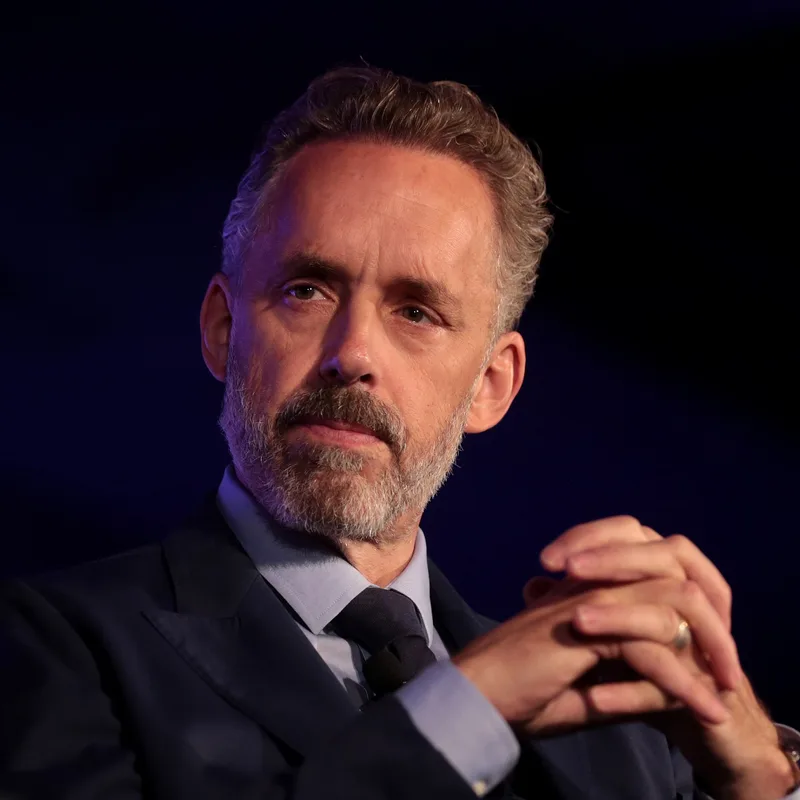
Jordan Peterson
Clinical psychologist, Author, born 1962
Christian, unsure of God
What is the meaning of life?
Take on responsibility; let meaning, not expedience, guide you through suffering.
Peterson, a clinical psychologist at the University of Toronto, starts from the claim that suffering is built into existence: finite creatures face an infinite reality, and life can be unbearable. His answer, set out in 12 Rules for Life (2018), is to take on responsibility voluntarily, turning the chaos of potential into habitable order and accepting the sacrifices that a productive and meaningful life requires. One chapter of the book, as he put it in an interview, is about doing what is meaningful rather than what is expedient. He has asked what people would become if they let their sense of meaning be their guide, and says he believes there is a mode of being that lets people transcend suffering, which is why he calls himself a hopeless optimist.
-
“To stand up straight with your shoulders back is to accept the terrible responsibility of life, with eyes wide open. It means deciding to voluntarily transform the chaos of potential into the realities of habitable order. … It means willingly undertaking the sacrifices necessary to generate a productive and meaningful reality (it means acting to please God, in the ancient language).”1
-
“I'm a hopeless optimist. That's because I actually believe that despite the fact that I believe that suffering is an ultimate reality, I do believe that there's a mode of being that allows people to transcend it.”2
-
“I have a chapter called 'Do What's Meaningful Not Expedient.' If everyone decided they were going to allow their sense of meaning to be their guide, what would they become?”2
What is the meaning of the universe?
Unsure whether God exists; religion is behaviour codified through myth.
Peterson approaches religion mainly as a psychologist. In Maps of Meaning (1999) he argued that behaviour is first imitated, then shaped into drama, story and myth, and codified into religion before philosophy explains it. In his 2017 lecture series on the Bible he called the evidence for genuine religious experience incontrovertible but inexplicable, and described the idea of God as an attempt to abstract out the ideal. Asked in a 2018 National Post interview whether he believed in God, he said the proper answer was no, but that he was afraid He might exist; in a 2017 interview he had said that the most straightforward answer to whether he was a Christian was yes. He expanded on these views in We Who Wrestle with God (2024), a reading of books of the Hebrew Bible.
-
“I think the proper response to that is No, but I'm afraid He might exist.”3
-
“I know that the evidence for genuine religious experience is incontrovertible, but it's not explicable. So I don't want to explain it away. I want to pull back from that and leave it as a fact and a mystery, and then we're going to look at this from a rational perspective, and say that the initial formulation of the idea of God was an attempt to abstract out the ideal and to consider it as an abstraction outside its instantiation.”4
-
“Behavior is imitated, then abstracted into play, formalized into drama and story, crystallized into myth and codified into religion—and only then criticized in philosophy, and provided, post-hoc, with rational underpinnings.”5