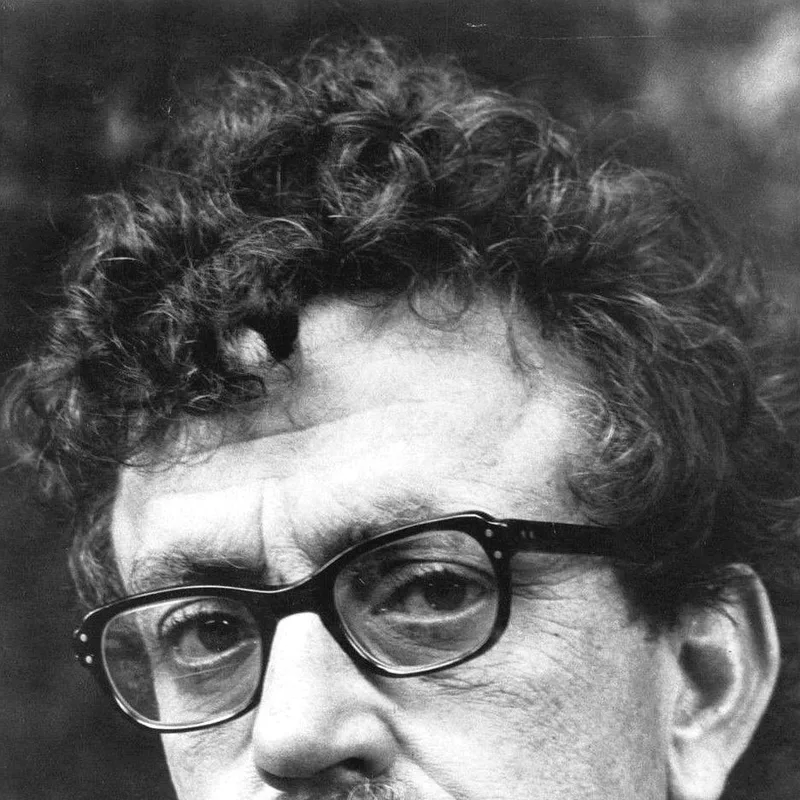
Kurt Vonnegut
Novelist, Essayist, 1922–2007
Humanist
What is the meaning of life?
To fart around, be kind, and help each other through this thing.
Vonnegut kept his answers deliberately small. In Timequake (1997) he passed on his son Mark's line that we are here to help each other get through this thing, whatever it is, and added his own: we are here on Earth to fart around, by which he meant the unplanned, sociable parts of a day — going out to buy one envelope, talking to strangers, dancing — that efficiency removes. In a 1974 commencement address he said the most daring thing young people could do was to build stable communities in which loneliness could be cured, and in a 1969 talk he reduced his ethics to be kind, don't kill, don't take more than you need, help others. From his uncle Alex he took the habit of noticing when he was happy and saying so. Behind all of it stood the Sermon on the Mount, which he said was the only reason he wanted to be a human being.
-
“We are here to help each other get through this thing, whatever it is.”1
-
“Listen: We are here on Earth to fart around. Don't let anybody tell you any different!”2
-
“I urge you to please notice when you are happy, and exclaim or murmur or think at some point, "If this isn't nice, I don't know what is."”3
-
“What should young people do with their lives today? Many things, obviously. But the most daring thing is to create stable communities in which the terrible disease of loneliness can be cured.”4
What is the meaning of the universe?
No God to reward or punish; be decent anyway — and astonished.
Vonnegut was raised by freethinking German-American parents and called himself a humanist, and once, in Palm Sunday (1981), a "Christ-worshipping agnostic". He followed Isaac Asimov as honorary president of the American Humanist Association and said that being a humanist meant trying to behave decently without expecting rewards or punishments after death. He mocked the designed universe — evolution, he told Jon Stewart in 2005, must be run by a divine engineer, which is why we have giraffes, hippopotami and the clap — yet in a 1970 address at Bennington College he begged graduates to hold the "ridiculous superstition" that humanity is at the centre of the universe, because the alternative was treating each other like garbage. Late in life he described his religion as "Our Lady of Perpetual Astonishment" and wrote that the only proof he needed for the existence of God was music.
-
“Some of you may know that I am neither Christian nor Jewish nor Buddhist, nor a conventionally religious person of any sort. I am a humanist, which means, in part, that I have tried to behave decently without any expectation of rewards or punishments after I'm dead.”5
-
“I beg you to believe in the most ridiculous superstition of all: that humanity is at the center of the universe, the fulfiller or the frustrator of the grandest dreams of God Almighty. If you can believe that, and make others believe it, then there might be hope for us. Human beings might stop treating each other like garbage, might begin to treasure and protect each other instead.”6
-
“I don't know about you, but I practice a disorganized religion. I belong to an unholy disorder. We call ourselves "Our Lady of Perpetual Astonishment."”7
-
“If I should ever die, God forbid, let this be my epitaph: THE ONLY PROOF HE NEEDED FOR THE EXISTENCE OF GOD WAS MUSIC.”8