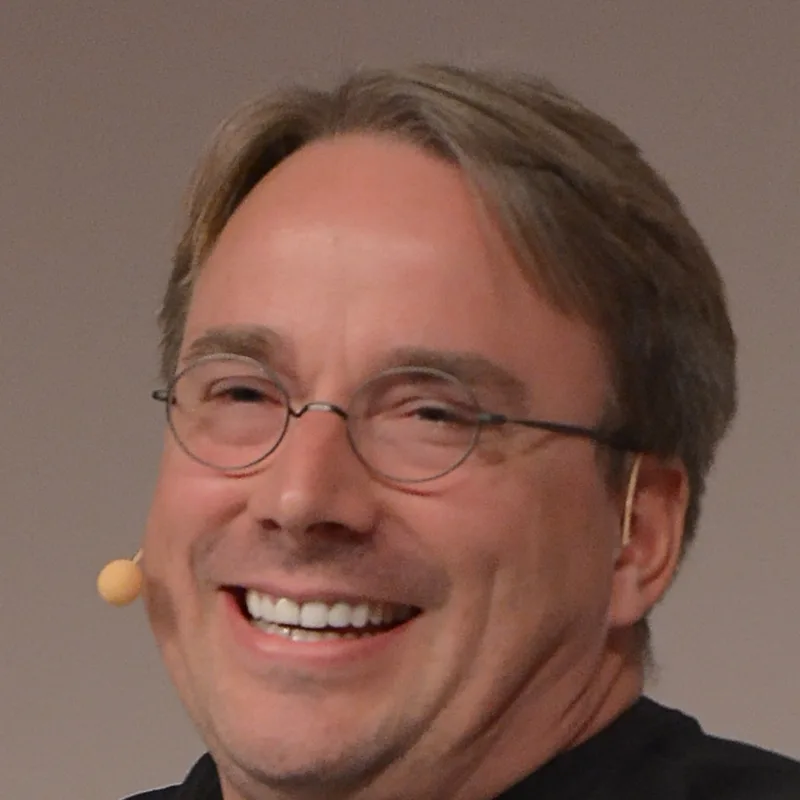
Linus Torvalds
Software engineer, Creator of Linux, born 1969
Atheist
What is the meaning of life?
Survival, then social order, then entertainment: we're here to have fun.
Torvalds gave his answer in the prologue to his 2001 memoir Just for Fun, half joking, in conversation with his co-author David Diamond. Everything a living thing does, he says, is driven by three things in that order: survival, social order and entertainment. There is nothing after entertainment, so the point of life is to reach the third stage, and in the end we are all here to have fun. His own work fits the pattern: he has said that good programmers program because it is fun, not for pay or applause, and that his two rules for life are the golden rule and being proud of what you do.
-
“There are three things that have meaning for life. They are the motivational factors for everything in your life—for anything that you do or any living thing does: The first is survival, the second is social order, and the third is entertainment. Everything in life progresses in that order. And there is nothing after entertainment. So, in a sense, the implication is that the meaning of life is to reach that third stage.”1
-
“So what this builds up to is that in the end we're all here to have fun. We might as well sit down and relax, and enjoy the ride.”1
-
“There are like two golden rules in life. One is 'Do unto others as you would want them to do unto you.' For some reason, people associate this with Christianity. I'm not a Christian. I'm agnostic. The other rule is 'Be proud of what you do.'”2
-
“I really don't think you need all that much "quid pro quo" in programming - most of the good programmers do programming not because they expect to get paid or get adulation by the public, but because it is fun to program.”3
What is the meaning of the universe?
Atheist: nature is more incredible if no one created it.
Asked about religion in a 1999 Linux Journal interview, Torvalds called himself completely a-religious, an atheist; in a newspaper profile the same year he said he was agnostic, and in 2023 he described himself as a card-carrying atheist. His objection is partly to organized religion, which he said he fears because it leads to misuses of power. But it is also about how belief shapes one's view of nature: calling the world created makes creation a miracle, while he finds it more incredible that something like this could have happened on its own. He grew up in Finland and has said religion is a personal matter that does not matter for anything else, and he has kept it that way. In his account nothing stands behind the universe; the wonder is that it is here at all.
-
“Hmmm, completely a-religious—atheist. I find that people seem to think religion brings morals and appreciation of nature. I actually think it detracts from both. It gives people the excuse to say, "Oh, nature was just created", and so the act of creation is seen to be something miraculous. I appreciate the fact that, "Wow, it's incredible that something like this could have happened in the first place."”4
-
“I think we can have morals without getting religion into it, and a lot of bad things have come from organized religion in particular. I actually fear organized religion because it usually leads to misuses of power.”4
-
“Religion is a personal matter, but does not matter for anything else. That's how I think it should be done.”4
-
“I'm personally convinced that computer science has a lot in common with physics. Both are about how the world works at a rather fundamental level. The difference, of course, is that while in physics you're supposed to figure out how the world is made up, in computer science you create the world. Within the confines of the computer, you're the creator. You get to ultimately control everything that happens. If you're good enough, you can be God. On a small scale.”5