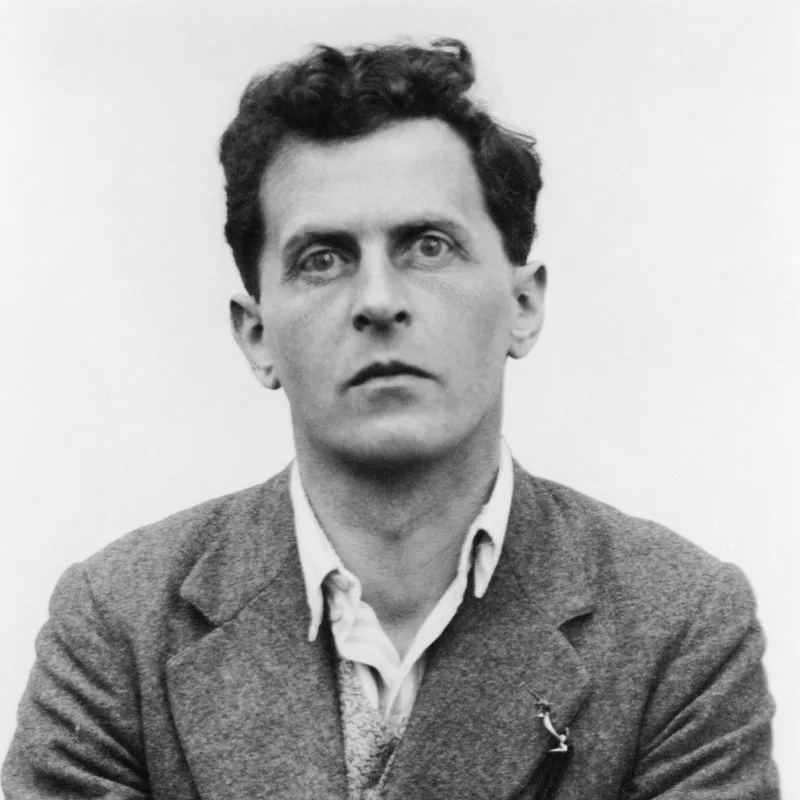
Ludwig Wittgenstein
Philosopher, 1889–1951
Mystical agnostic
What is the meaning of life?
Not a question science answers; solved when the problem vanishes.
Wittgenstein's Tractatus (1921) draws a line around what language can say: the facts, the business of the natural sciences. The meaning of life falls outside that line. Even if every scientific question were answered, he wrote, the problems of life would not have been touched; and when the question vanishes, that is the answer. In the notebooks he kept as a soldier in 1916 he tried out answers anyway — that to believe in God is to see that life has a meaning, and that only someone who lives in the present, not in time, is happy. He kept most of this out of print, and the Tractatus ends by telling the reader to pass over in silence what cannot be said.
-
“We feel that even if all possible scientific questions be answered, the problems of life have still not been touched at all. Of course there is then no question left, and just this is the answer.”1
-
“The solution of the problem of life is seen in the vanishing of this problem. (Is not this the reason why men to whom after long doubting the sense of life became clear, could not then say wherein this sense consisted?)”2
-
“Death is not an event in life: we do not live to experience death. If we take eternity to mean not infinite temporal duration but timelessness, then eternal life belongs to those who live in the present. Our life has no end in just the way in which our visual field has no limits.”3
-
“To believe in a God means to understand the question about the meaning of life. To believe in a God means to see that the facts of the world are not the end of the matter. To believe in God means to see that life has a meaning.”4
What is the meaning of the universe?
All that is the case; the mystical is that it exists.
For the early Wittgenstein the world is the totality of facts, and facts are all that propositions can picture. Everything higher — value, ethics, God — lies outside the world, so nothing can be said about it; it shows itself. What struck him as mystical was not how the world is but that it exists at all, and in a 1929 lecture on ethics he described wondering at the existence of the world as his central religious experience. He was baptised a Catholic, carried Tolstoy's Gospel in Brief through the First World War, and respected religious belief without holding its doctrines, telling a friend he could not help seeing every problem from a religious point of view. Science, on his account, explains how the world is; that there is a world is left untouched.
-
“The world is all that is the case.”5
-
“How the world is, is completely indifferent for what is higher. God does not reveal himself in the world.”6
-
“Not how the world is, is the mystical, but that it is.”7
-
“What do I know about God and the purpose of life? I know that this world exists. That I am placed in it like my eye in its visual field. That something about it is problematic, which we call its meaning. This meaning does not lie in it but outside of it. … The meaning of life, i.e. the meaning of the world, we can call God.”8