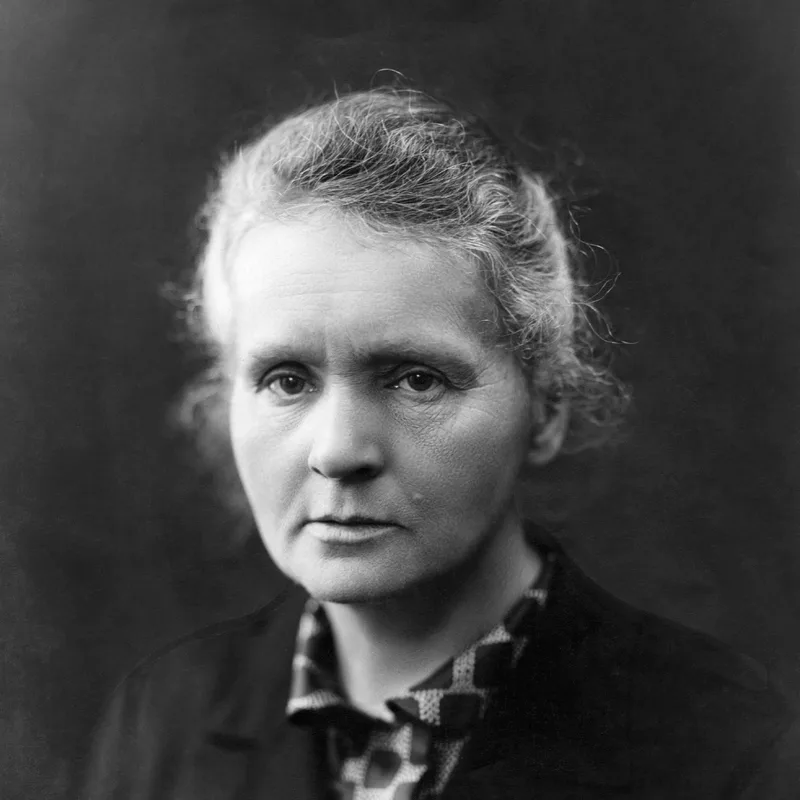
Marie Curie
Physicist, Chemist, 1867–1934
Agnostic
What is the meaning of life?
Improve yourself, aid those you can, do the work for itself.
Curie's answer comes from the Autobiographical Notes she wrote in 1923 for the American edition of her life of Pierre. Looking back at her youth in Warsaw's clandestine Flying University, she wrote that a better world is built only by improving individuals: each of us must work on our own improvement while taking a share of responsibility for humanity, helping those we can be most useful to. Scientific work itself belonged inside that duty. At Vassar in 1921 she said research must be done for itself, for the beauty of science, and that usefulness, like radium's use in hospitals, follows on its own. She also defended the dreamers: people for whom following a purpose matters more than material gain, and whom a well-organized society ought to support.
-
“You cannot hope to build a better world without improving the individuals. To that end each of us must work for his own improvement, and at the same time share a general responsibility for all humanity, our particular duty being to aid those to whom we think we can be most useful.”1
-
“We must not forget that when radium was discovered no one knew that it would prove useful in hospitals. The work was one of pure science. And this is a proof that scientific work must not be considered from the point of view of the direct usefulness of it. It must be done for itself, for the beauty of science, and then there is always the chance that a scientific discovery may become like the radium a benefit for humanity.”2
-
“Humanity, surely, needs practical men who make the best of their work for the sake of their own interests, without forgetting the general interest. But it also needs dreamers, for whom the unselfish following of a purpose is so imperative that it becomes impossible for them to devote much attention to their own material benefit.”1
What is the meaning of the universe?
No religion. Nature, lawful and still mysterious, met with wonder.
Curie was raised by a devout Catholic mother and an atheist father, and lost her faith as a girl after her sister and then her mother died. She wrote almost nothing about God afterwards. What she did record is that she practised no religion, and that she and Pierre married in a civil ceremony for that reason. Her picture of the world came from the laboratory: radioactivity showed her atoms that transform spontaneously according to the laws of probability, from causes still unknown, overturning the idea of unchanging matter. What she brought to that world was not belief but wonder — nature, she said, made her rejoice like a child all her life, and the scientist stands before its phenomena as before a fairy tale.
-
“In conformity with our mutual wish it was the simplest service possible,—a civil ceremony, for Pierre Curie professed no religion, and I myself did not practice any.”3
-
“The exponential law has a profound philosophic bearing; it indicates that the transformation is produced according to the laws of probability. The causes that determine the transformation are a mystery to us, and we do not yet know if they derive from causal conditions outside the atom, or from conditions of internal instability.”4
-
“All my life through, the new sights of Nature made me rejoice like a child.”1
-
“I am among those who think that science has great beauty. A scientist in his laboratory is not only a technician: he is also a child placed before natural phenomena which impress him like a fairy tale.”5