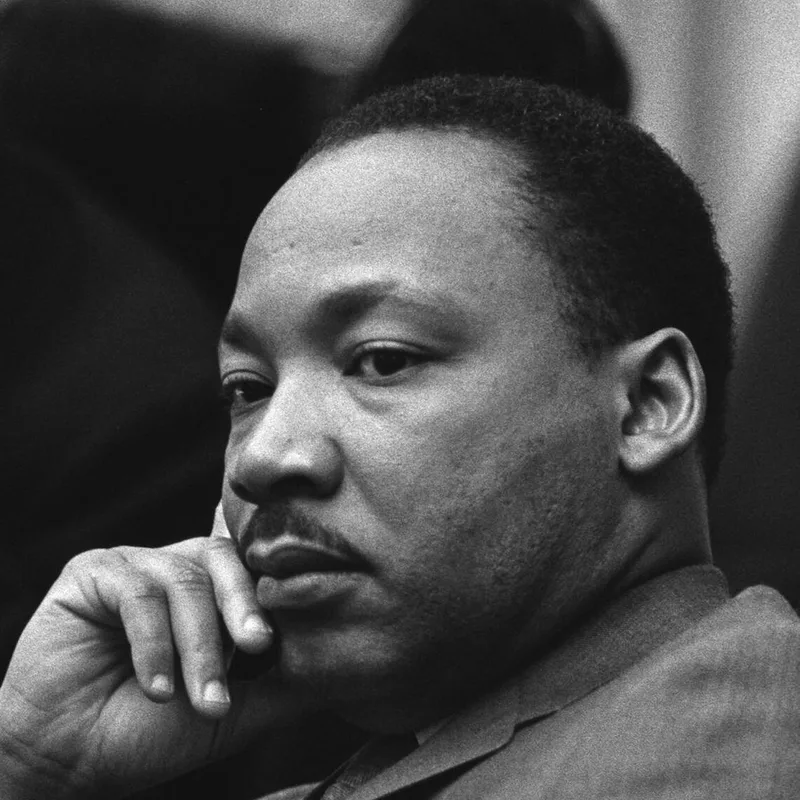
Martin Luther King Jr.
Baptist minister, Civil rights leader, 1929–1968
Baptist
What is the meaning of life?
A complete life: love of self, of others, and of God.
King answered as a preacher, most fully in a sermon he gave in many versions from 1954 on, The Three Dimensions of a Complete Life. Life has length, the inward concern for one's own welfare; breadth, the outward concern for the welfare of others; and height, the upward reach for God. A complete life holds all three together: rational self-interest, love of neighbour and love of God. In a 1957 sermon at Dexter Avenue he said a person has not begun to live until he rises above his own concerns to those of all humanity, and in The Drum Major Instinct, two months before his death, he defined greatness as service, open to anyone because anyone can serve.
-
“The length of life, as we shall use it here, is not its longevity, its duration, not how long it lasts, but it is a push, the push of a life forward to achieve its personal ends and ambitions. It is the inward concern for one's own welfare. The breadth of life is the outward concern for the welfare of others. The height of life is the upward reach for God.”1
-
“An individual has not begun to live until he can rise above the narrow horizons of his particular individualistic concerns to the broader concerns of all humanity.”2
-
“If you want to be important — wonderful. If you want to be recognized — wonderful. If you want to be great — wonderful. But recognize that he who is greatest among you shall be your servant. That's a new definition of greatness. … by giving that definition of greatness, it means that everybody can be great, because everybody can serve.”3
What is the meaning of the universe?
A personal God; a universe under the control of a loving purpose.
King was a Baptist minister who took a doctorate in systematic theology at Boston University in 1955, with a dissertation comparing the conceptions of God of Paul Tillich and Henry Nelson Wieman. He believed in a personal God — not, he said, an Aristotelian Unmoved Mover contemplating himself, but an other-loving God working through history. In a 1960 essay for The Christian Century he wrote that this personal God, once a satisfying metaphysical category, had become a living reality through the hardships of the struggle, and that the universe is under the control of a loving purpose. The same conviction stands behind his line that the arc of the moral universe is long but bends toward justice: there is a moral order.
-
“I am convinced that the universe is under the control of a loving purpose and that in the struggle for righteousness man has cosmic companionship. Behind the harsh appearances of the world there is a benign power.”4
-
“In recent months I have also become more and more convinced of the reality of a personal God. True, I have always believed in the personality of God. But in past years the idea of a personal God was little more than a metaphysical category which I found theologically and philosophically satisfying. Now it is a living reality that has been validated in the experiences of everyday life.”4
-
“This is the long faith of the Hebraic-Christian tradition: that God is not some Aristotelian Unmoved Mover who merely contemplates upon himself. He is not merely a self-knowing God, but an other-loving God forever working through history for the establishment of His kingdom.”5
-
“I have not lost faith. I'm not in despair, because I know that there is a moral order. I haven't lost faith, because the arc of the moral universe is long, but it bends toward justice.”6