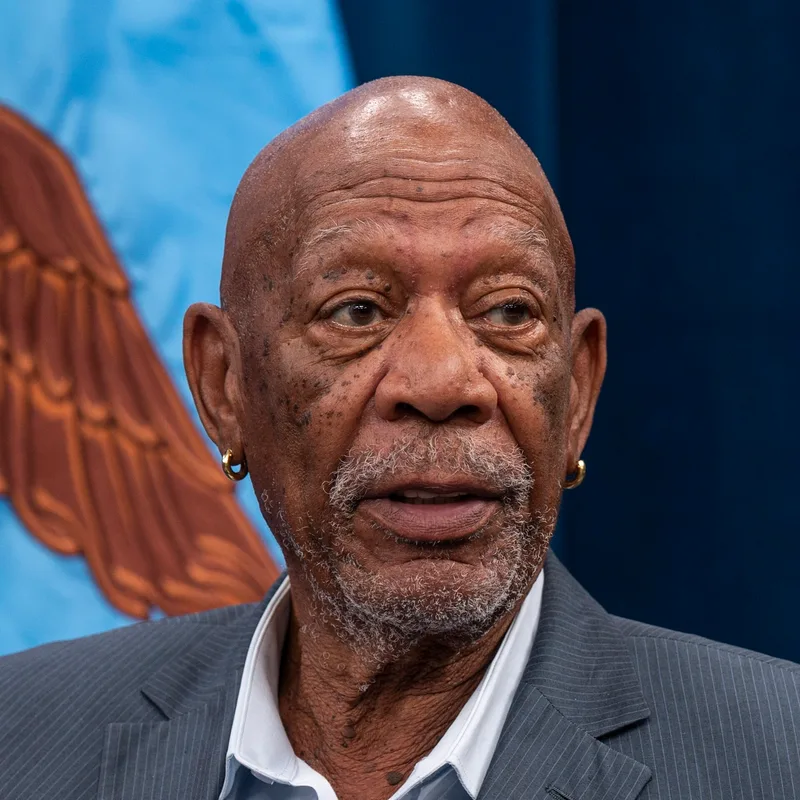
Morgan Freeman
Actor, Documentary host, born 1937
No creator; Zoroastrian ethics
What is the meaning of life?
Act on what you can; good thoughts, good words, good deeds.
Freeman has not offered a theory of life's purpose. Promoting The Story of God in 2016, he called himself a lifelong student of religion who had not landed on any conclusions: the big questions — why am I here, what is my purpose — resonate with him, and science does not answer them all. His working rules are practical. In a 2014 interview he said he does not worry: if he can do something about a problem he gets up and does it, and if he cannot, he does not think about it. After three seasons of the series he said that if he could claim a religion it was Zoroastrianism, whose three tenets — good thoughts, good words, good deeds — work for him.
-
“I call myself a lifelong student of religion. But I haven't landed on any conclusions. I can relate to the big questions that most of us ask ourselves: Why am I here? What's my purpose? How did we get here? Those questions resonate with me.”1
-
“I came to this conclusion some time back: if I can do something about it, then it behooves me to get off my duff and go do it. If I can't do anything about it, I don't need to think about it.”2
-
“In Bohemian Rhapsody, Freddie's father said its tenets: "good thoughts, good words, good deeds." That's it. It works for me.”3
What is the meaning of the universe?
We invented God — and God is the great unknown.
Freeman grew up with God — his grandmother was a believer — and by thirteen he had begun to question what children are told about it, a questioning he calls ongoing. Hosting the science series Through the Wormhole, he said in 2012 that he had seen no hard evidence of a creator who made us in his image and that he thought humans invented God, adding that if he believes in God, it is because he thinks he is God. In 2014 he called the human mind the highest power, the place God came from. Making The Story of God (2016–2019), he concluded that religions share remarkable commonalities and that their purpose is cohesion: they hold societies together. The God he points to is the night sky — the Milky Way, a full moon, the great unknown.
-
“Well, here's a scientific question: Has anybody ever seen hard evidence? What we get is theories from our earlier prophets. Now, people who think that God invented us think that the Earth can't be more than 6,000 years old. So I guess it's a question of belief. My belief system doesn't support a creator as such, as we can call God, who created us in His/Her/Its image.”4
-
“It's a hard question because as I said at the start, I think we invented God. So if I believe in God, and I do, it's because I think I'm God.”5
-
“Well, I don't think there is an image of God. I like the rays coming down from the clouds. I like seeing the Milky Way on a clear night. I like seeing 1,000 feet forward on the night of a full moon. That's God. That is the essence of existence. You're there with the great unknown.”6