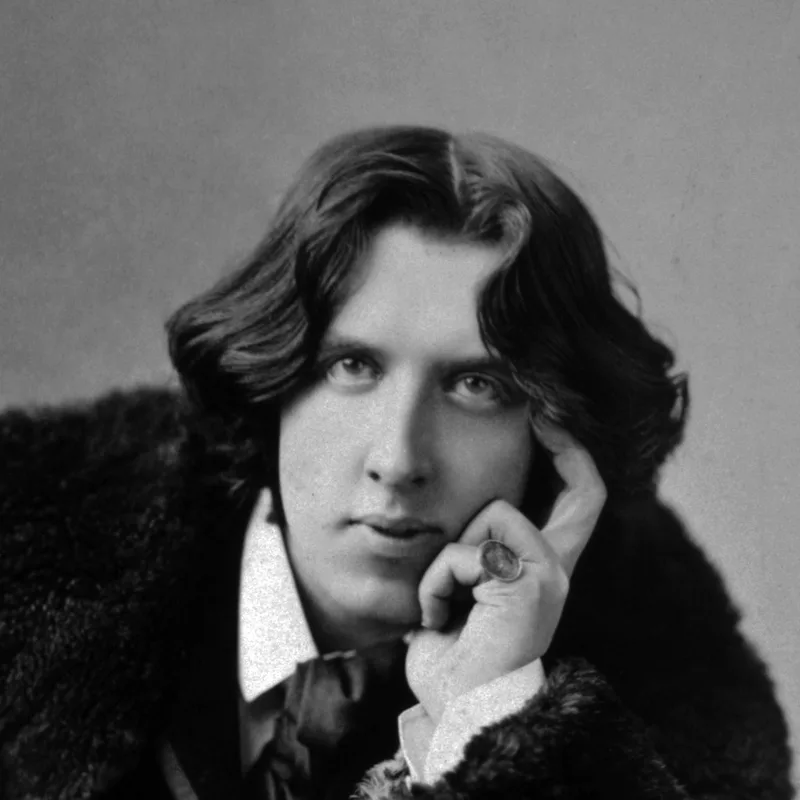
Oscar Wilde
Playwright, Novelist, Essayist, 1854–1900
Individualist
What is the meaning of life?
To live, not merely exist; then to learn what sorrow teaches.
In The Soul of Man Under Socialism (1891) Wilde argued that the point of abolishing private property was to free people to live, which most of them never do: they only exist. The aim was a full and joyful individualism, and he read the message of Christ as simply "Be thyself". Prison changed the emphasis without cancelling it. In De Profundis, the long letter to Lord Alfred Douglas he wrote in prison in early 1897, he said he had wanted to eat the fruit of every tree in the garden of the world but had kept to its sunlit side; now he called sorrow holy ground and suffering a revelation, and described this new life as a continuation of the old one.
-
“Nobody will waste his life in accumulating things, and the symbols for things. One will live. To live is the rarest thing in the world. Most people exist, that is all.”1
-
“‘Know thyself’ was written over the portal of the antique world. Over the portal of the new world, ‘Be thyself’ shall be written. And the message of Christ to man was simply ‘Be thyself.’ That is the secret of Christ.”1
-
“I wanted to eat of the fruit of all the trees in the garden of the world … And so, indeed, I went out, and so I lived. My only mistake was that I confined myself so exclusively to the trees of what seemed to me the sun-lit side of the garden, and shunned the other side for its shadow and its gloom.”2
What is the meaning of the universe?
A God hidden from man; faith given to what one can touch.
Wilde was baptised in the Church of Ireland, and Catholicism drew him all his life: in 1878, as an Oxford student, he came close to converting, then on the appointed day sent the priest a bunch of altar lilies instead. In De Profundis he wrote that religion did not help him: his faith went to what can be touched and looked at, and his creed was actual experience. He imagined an order for those who cannot believe, where agnosticism would have its own ritual and praise God for having hidden himself, and he set the self, not the measured heavens, as the final mystery. After his release in 1897 he asked the Jesuits for a retreat and was refused; on his deathbed in Paris in 1900 he was received into the Catholic Church.
-
“Religion does not help me. The faith that others give to what is unseen, I give to what one can touch, and look at. My gods dwell in temples made with hands; and within the circle of actual experience is my creed made perfect and complete: too complete, it may be, for like many or all of those who have placed their heaven in this earth, I have found in it not merely the beauty of heaven, but the horror of hell also.”2
-
“Every thing to be true must become a religion. And agnosticism should have its ritual no less than faith. It has sown its martyrs, it should reap its saints, and praise God daily for having hidden Himself from man.”2
-
“The final mystery is oneself. When one has weighed the sun in the balance, and measured the steps of the moon, and mapped out the seven heavens star by star, there still remains oneself. Who can calculate the orbit of his own soul?”2