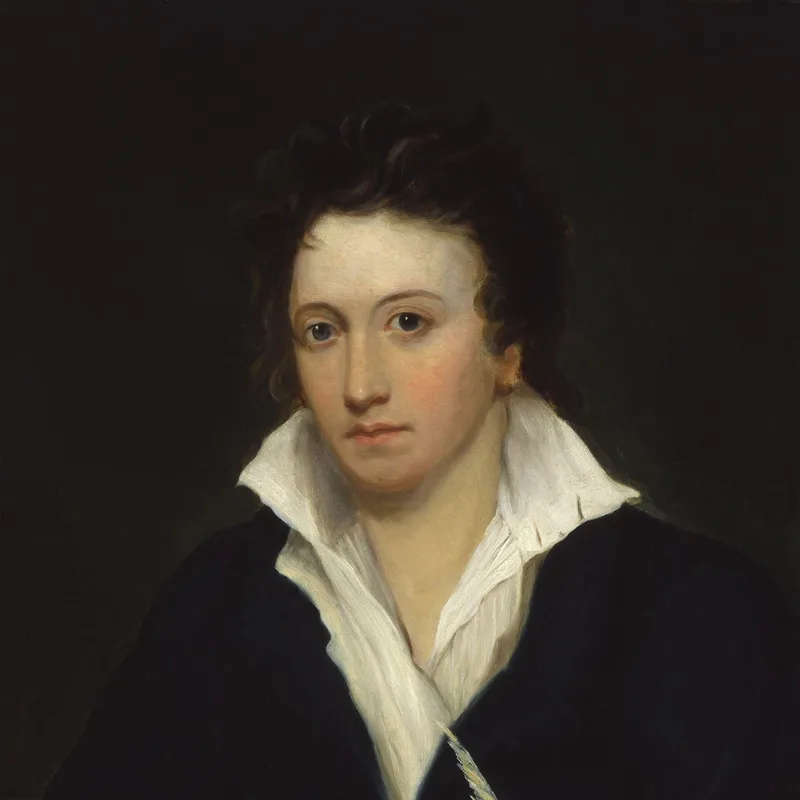
Percy Bysshe Shelley
Poet, 1792–1822
Romantic atheist
What is the meaning of life?
Love is the great secret: going out of ourselves into others.
Shelley was expelled from Oxford in 1811 for a pamphlet called The Necessity of Atheism, and lived the rest of his short life as a radical in politics, religion and love. He drowned off the coast of Italy at twenty-nine. In A Defence of Poetry, written in 1821, he argued that morality rests on love: the power to go out of ourselves and feel the pains and pleasures of others as our own. Imagination, which poetry trains, is the great instrument of moral good.
-
“The great secret of morals is love; or a going out of our own nature, and an identification of ourselves with the beautiful which exists in thought, action, or person, not our own. A man, to be greatly good, must imagine intensely and comprehensively; he must put himself in the place of another and of many others; the pains and pleasures of his species must become his own.”1
What is the meaning of the universe?
No creator God, though a Spirit may pervade the universe.
Shelley's first long poem, Queen Mab (1813), carried a note that begins “There is no God”, followed at once by a qualification: what he denied was a creator, not a spirit pervading the universe and eternal with it. In 1816 he described himself in a hotel register, in Greek, as a democrat, a lover of humanity and an atheist. His later poetry, influenced by Plato, often speaks of a One beyond the changing world. In Adonais (1821), his elegy for Keats, earthly life stains the white radiance of eternity until death breaks it apart.
-
“There is no God. This negation must be understood solely to affect a creative Deity. The hypothesis of a pervading Spirit co-eternal with the universe remains unshaken.”2
-
“The One remains, the many change and pass; / Heaven's light forever shines, Earth's shadows fly; / Life, like a dome of many-coloured glass, / Stains the white radiance of Eternity, / Until Death tramples it to fragments.”3