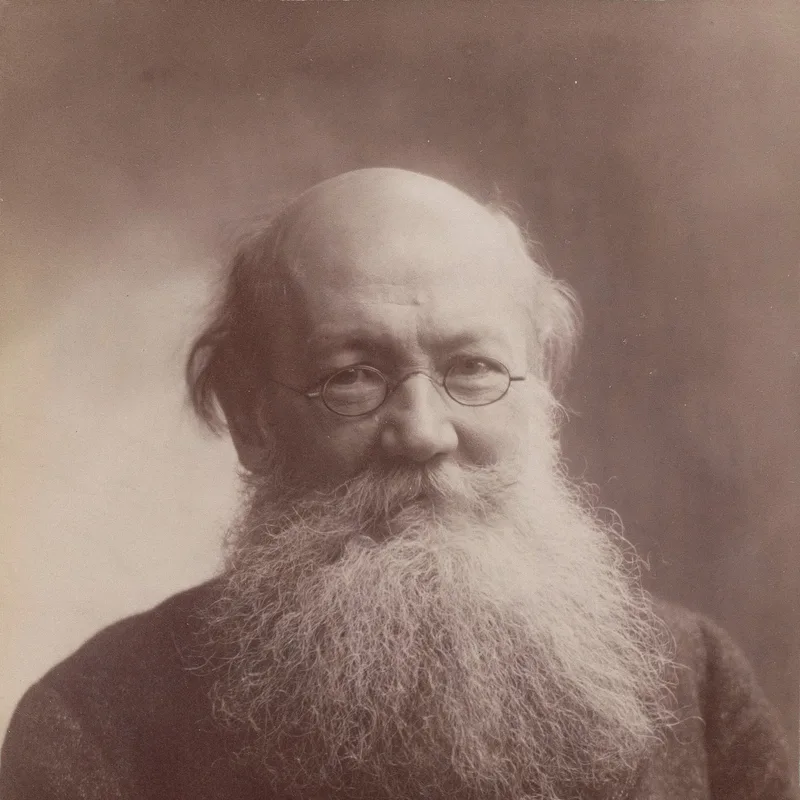
Peter Kropotkin
Anarchist thinker, Geographer, 1842–1921
Anarchist and atheist
What is the meaning of life?
Be strong, overflow with energy, and sow life around you.
Kropotkin was a Russian prince who gave up his title, explored Siberia as a geographer, escaped from a Russian prison in 1876 and spent forty years in exile in Western Europe, becoming the leading theorist of anarchist communism. In Mutual Aid (1902) he answered the social Darwinists by showing how much cooperation, and not only competition, drives evolution. His ethics needed neither God nor law: the moral person is simply one overflowing with life, who gives without calculating, as a flower blooms. Be strong, he wrote in Anarchist Morality, overflow with emotional and intellectual energy, and you will spread your intelligence and your love among others; this is what all moral teaching comes to.
-
“Be strong. Overflow with emotional and intellectual energy, and you will spread your intelligence, your love, your energy of action broadcast among others! This is what all moral teaching comes to.”1
-
“…if you wish to live, if you wish to enjoy a perfect, full and overflowing life — that is, know the highest pleasure which a living being can desire — be strong, be great, be vigorous in all you do. Sow life around you.”2
What is the meaning of the universe?
Science, not religion, can tell us how the universe began.
Kropotkin was an atheist and a materialist who believed that the natural sciences had replaced religion as the way to understand the world, and that the church, like the state and the law, served the powerful. In An Appeal to the Young (1880) he lamented that more than a century after science had laid down sound propositions about the origins of the universe, only a few thousand people had truly mastered them, while hundreds of millions remained steeped in superstition, ready to serve as puppets for religious impostors. In their place he hoped for a morality freed from God and from fear of punishment, grounded in the natural sympathy and mutual aid he had observed throughout the living world.
-
“More than a century has passed since science laid down sound propositions as to the origins of the universe, but how many have mastered them or possess the really scientific spirit of criticism? A few thousands at the outside, who are lost in the midst of hundreds of millions still steeped in prejudices and superstitions worthy of savages, who are consequently ever ready to serve as puppets for religious impostors.”3