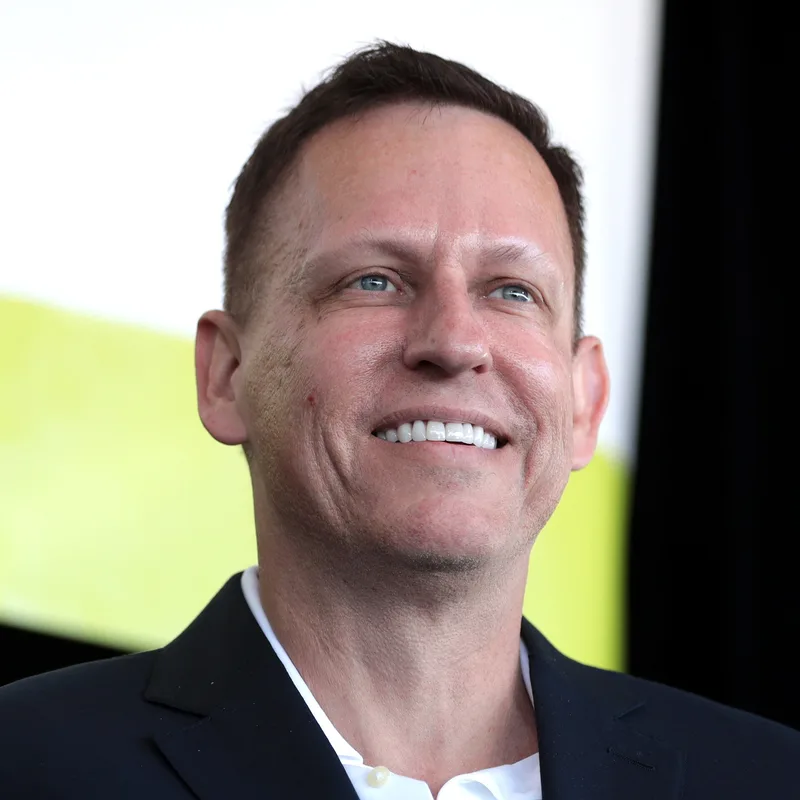
Peter Thiel
Entrepreneur, Investor, born 1967
Heterodox Christian
What is the meaning of life?
Build the future and fight death; God works through us.
Thiel's answer runs through his hostility to death. He has said people meet death in one of three ways — acceptance, denial or fighting it — and that he prefers to fight; in a 2009 essay he listed "the ideology of the inevitability of the death of every individual" among the things he stands against. Zero to One (2014) closes with the task he sets for a working life: to create new things that make the future not just different but better. In "Against Edenism" (2015) he joined this to his faith: science and technology are allies of a Christianity in which God works through people to build the kingdom of heaven here, and he asks why saving one's soul and reclaiming the world should be mutually exclusive.
-
“You can accept it, you can deny it or you can fight it. I think our society is dominated by people who are into denial or acceptance, and I prefer to fight it.”1
-
“People always say you should live your life as if it were your last day. I think you should live your life as though it will go on for ever; that every day is so good that you don't want it to end.”1
-
“Everything important to us—the universe, the planet, the country, your company, your life, and this very moment—is singular. Our task today is to find singular ways to create the new things that will make the future not just different, but better—to go from 0 to 1.”2
-
“Science and technology are natural allies to this Judeo-Western optimism, especially if we remain open to an eschatological frame in which God works through us in building the kingdom of heaven today, here on Earth—in which the kingdom of heaven is both a future reality and something partially achievable in the present.”3
What is the meaning of the universe?
Christianity is true: chaos gives way to the providence of God.
Thiel grew up in an evangelical household and calls himself a Christian, while describing his beliefs as heterodox: he thinks Christianity is true and feels no need to convince anyone of it. The frame comes largely from René Girard, whom he met at Stanford: human culture rests on imitation, rivalry and the sacrifice of scapegoats, and the Christian revelation exposes this mechanism and so unsettles the old order. In "The Straussian Moment" (2007) he wrote that the Christian knows the modern age will not last, and that one day all will be revealed and every injustice held to account. In "Against Edenism" (2015) he set this against both the atheist optimism of the Enlightenment and the atheist pessimism of today, which accepts a universe of chance and accident; for him the story runs from chaos toward order, and chance gives way to the providence of God.
-
“I believe Christianity is true but I don't sort of feel a compelling need to convince other people of that.”4
-
“Judeo-Western optimism differs from the atheist optimism of the Enlightenment in the extreme degree to which it believes that the forces of chaos and nature can and will be mastered. The tyranny of Chance will give way to the providence of God.”3
-
“If atheist optimism meant an escape from nature, then today's atheist pessimism means an acceptance of nature, and of the many gruesome accidents and the terrible rule of chance that that entails. The physical theories of our age resemble the Epicurean accounts of the atoms randomly moving through the void, and it should be no wonder that quasi-Epicurean physics naturally lead to Stoicism and Epicurean hedonism.”3
-
“Unlike Strauss, the Christian statesman or stateswoman knows that the modern age will not be permanent, and ultimately will give way to something very different. One must never forget that one day all will be revealed, that all injustices will be exposed, and that those who perpetrated them will be held to account.”5