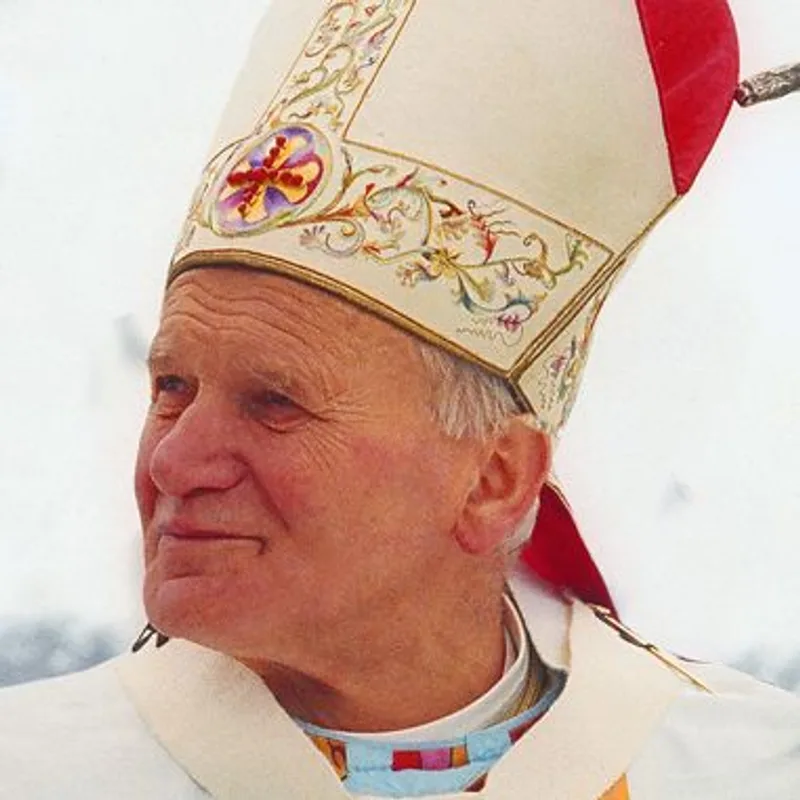
Pope John Paul II
Pope, Philosopher, 1920–2005
Catholic
What is the meaning of life?
Without love, life is senseless; Christ gives it its meaning.
Karol Wojtyła, a Polish priest and professor of ethics who became pope in 1978, had worked out a philosophy that joined Thomism with personalism. In his first encyclical, Redemptor hominis (1979), he wrote that man cannot live without love: unless he encounters love and makes it his own, his life is senseless, and it is Christ who fully reveals man to himself. At the Mass inaugurating his pontificate in October 1978 he said that people were so often uncertain about the meaning of their life on earth, and asked the world to let Christ speak to them. Twenty years later, in Fides et ratio (1998), he described the desire for truth as placed in the human heart by God, so that by knowing and loving God people come to the fullness of truth about themselves.
-
“Man cannot live without love. He remains a being that is incomprehensible for himself, his life is senseless, if love is not revealed to him, if he does not encounter love, if he does not experience it and make it his own, if he does not participate intimately in it.”1
-
“So often today man does not know what is within him, in the depths of his mind and heart. So often he is uncertain about the meaning of his life on this earth. He is assailed by doubt, a doubt which turns into despair. We ask you therefore, we beg you with humility and trust, let Christ speak to man. He alone has words of life, yes, of eternal life.”2
-
“Faith and reason are like two wings on which the human spirit rises to the contemplation of truth; and God has placed in the human heart a desire to know the truth—in a word, to know himself—so that, by knowing and loving God, men and women may also come to the fullness of truth about themselves.”3
What is the meaning of the universe?
A free, personal Creator; a universe moving toward fulfilment in God.
John Paul II held the Catholic faith in a free and personal God who created the world; in Fides et ratio (1998) he counted it among the truths that revelation proposes and reason alone might never have found. He sought a dialogue with science. In a 1988 letter to the director of the Vatican Observatory he wrote that science can purify religion from error and superstition, and religion can purify science from idolatry and false absolutes, and in 1996 he told the Pontifical Academy of Sciences that new knowledge had led to the recognition of evolution as more than a hypothesis, while holding that the spiritual soul is created directly by God. Of the last things he taught, in general audiences in July 1999, that heaven is not a place in the clouds but a living, personal relationship with the Trinity, and that hell is the state of those who freely and definitively separate themselves from God.
-
“Revelation clearly proposes certain truths which might never have been discovered by reason unaided, although they are not of themselves inaccessible to reason. Among these truths is the notion of a free and personal God who is the Creator of the world, a truth which has been so crucial for the development of philosophical thinking, especially the philosophy of being.”4
-
“There is, of course, the vision of the unity of all things and all peoples in Christ … This vision carries with it into the larger community a deep reverence for all that is, a hope and assurance that the fragile goodness, beauty and life we see in the universe is moving towards a completion and fulfilment which will not be over-whelmed by the forces of dissolution and death.”5
-
“In the context of Revelation, we know that the “heaven” or “happiness” in which we will find ourselves is neither an abstraction nor a physical place in the clouds, but a living, personal relationship with the Holy Trinity. It is our meeting with the Father which takes place in the risen Christ through the communion of the Holy Spirit.”6