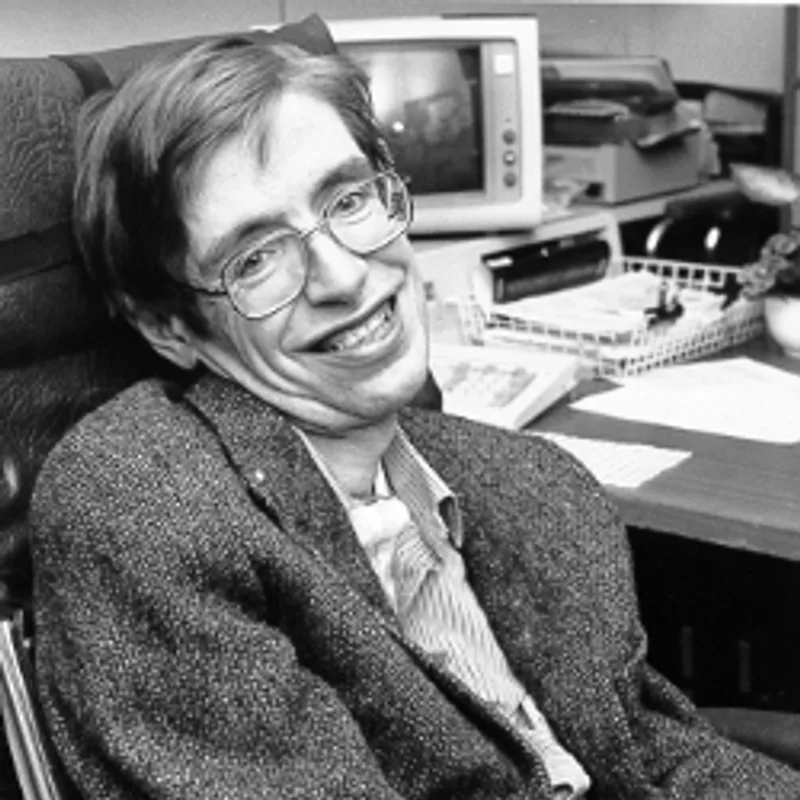
Stephen Hawking
Theoretical physicist, Cosmologist, 1942–2018
Atheist
What is the meaning of life?
No afterlife. One life to understand the universe, and be grateful.
Hawking gave his answer late, in interviews rather than books. He regarded the brain as a computer that stops working when its components fail; there is no heaven for broken-down computers, and he called the afterlife a fairy story for people afraid of the dark. What is left is this one life, and his advice was to use it: asked in 2011 how we should live, he answered that we should seek the greatest value of our action. The thing that makes humans special, he had said in 1988, is that an advanced breed of monkeys on a minor planet can nonetheless understand the universe. In the 2011 film Curiosity he added gratitude: we have one life in which to appreciate the grand design of the universe.
-
“We are just an advanced breed of monkeys on a minor planet of a very average star. But we can understand the Universe. That makes us something very special.”1
-
“I have lived with the prospect of an early death for the last 49 years. I'm not afraid of death, but I'm in no hurry to die. I have so much I want to do first ... I regard the brain as a computer which will stop working when its components fail. There is no heaven or afterlife for broken down computers; that is a fairy story for people afraid of the dark.”2
-
“We should seek the greatest value of our action.”3
-
“Life would be tragic if it weren't funny.”4
What is the meaning of the universe?
Laws, not a creator: the universe makes itself from nothing.
In A Brief History of Time (1988) Hawking still used the word God. The book ends with the hope of knowing the mind of God, and his no-boundary proposal described a universe that is self-contained, neither created nor destroyed. He said at the time that this did not disprove God, only that God was not necessary. In The Grand Design (2010) he went further: because there is a law such as gravity, the universe can create itself from nothing, and no creator is needed to set it going. He rejected a personal God outright, allowed only that one could call the laws of science God, and in Curiosity (2011) said plainly that the simplest explanation is that there is no God and no one directs our fate.
-
“If we do discover a complete theory, it should in time be understandable in broad principle by everyone, not just a few scientists. Then we shall all, philosophers, scientists, and just ordinary people, be able to take part in the discussion of the question of why it is that we and the universe exist. If we find the answer to that, it would be the ultimate triumph of human reason — for then we would know the mind of God.”5
-
“What I have done is to show that it is possible for the way the universe began to be determined by the laws of science. In that case, it would not be necessary to appeal to God to decide how the universe began. This doesn't prove that there is no God, only that God is not necessary.”1
-
“Because there is a law such as gravity, the universe can and will create itself from nothing. Spontaneous creation is the reason there is something rather than nothing, why the universe exists, why we exist. It is not necessary to invoke God to light the blue touch paper and set the universe going.”6
-
“We are each free to believe what we want and it is my view that the simplest explanation is there is no God. No one created the universe and no one directs our fate. This leads me to a profound realization. There is probably no heaven, and no afterlife either. We have this one life to appreciate the grand design of the universe, and for that, I am extremely grateful.”7