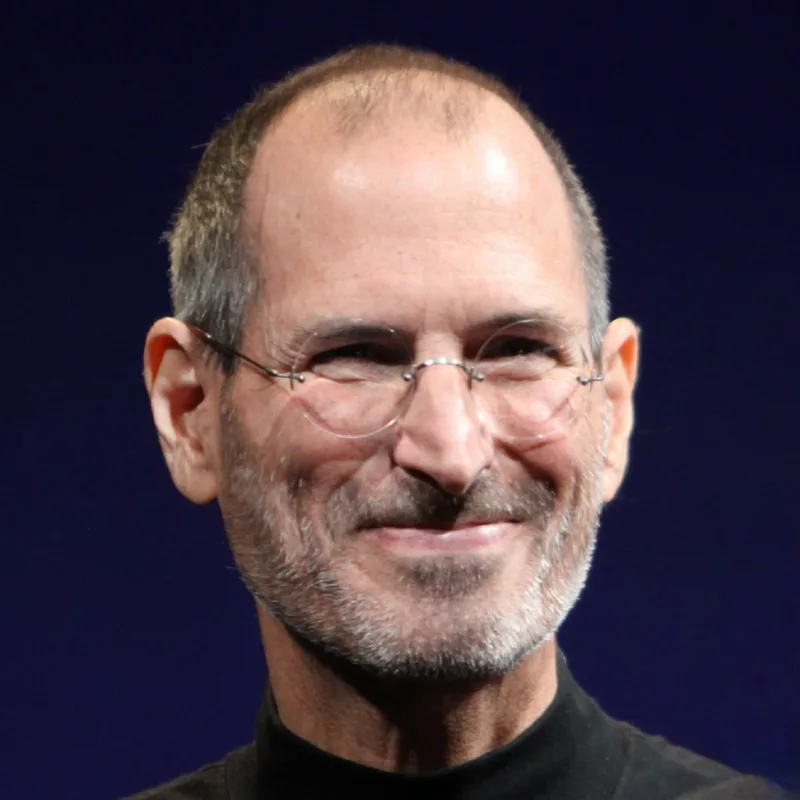
Steve Jobs
Co-founder of Apple, 1955–2011
Zen Buddhist
What is the meaning of life?
To do what you love, and add something to the flow.
Jobs gave his fullest answer in the 2005 Stanford commencement address, a year after his first cancer surgery. Time is limited, and death is life's change agent: it clears out the old to make way for the new, and remembering that you will die strips away pride and fear and leaves only what matters, so follow your heart and do work you love. Earlier, in a 1994 interview, he framed life as something to shape rather than live inside: the world was made by people no smarter than you, and you can change it. In a 2010 email to himself he listed everything he depended on and had not made — food, language, mathematics, laws, music. What he owed his species, he told his biographer, was to add something back to the flow.
-
“No one wants to die. Even people who want to go to heaven don't want to die to get there. And yet, death is the destination we all share. No one has ever escaped it. And that is as it should be, because death is very likely the single best invention of life. It's life's change agent. It clears out the old to make way for the new.”1
-
“Your time is limited, so don't waste it living someone else's life. Don't be trapped by dogma, which is living with the results of other people's thinking. Don't let the noise of others' opinions drown out your own inner voice. And most important, have the courage to follow your heart and intuition. They somehow already know what you truly want to become. Everything else is secondary.”1
-
“When you grow up you tend to get told that the world is the way it is and your life is just to live your life inside the world. … Life can be much broader once you discover one simple fact: Everything around you that you call life was made up by people that were no smarter than you and you can change it, you can influence it, you can build your own things that other people can use.”2
-
“I grow little of the food I eat, and of the little I do grow I did not breed or perfect the seeds. I do not make any of my own clothing. I speak a language I did not invent or refine. I did not discover the mathematics I use. … I love and admire my species, living and dead, and am totally dependent on them for my life and well being.”3
What is the meaning of the universe?
Fifty-fifty on God; religions are doors to one house.
Jobs left the Lutheran church at thirteen, after a pastor told him God knew about the starving children on a Life magazine cover. He turned to Zen Buddhism: a trip to India in 1974, then years of practice with the teacher Kobun Chino Otogawa in Los Altos. From it he kept the view that intuition sees more than intellect, and that a quiet mind opens onto a wider reality. He never settled the question of God: he told Walter Isaacson that religions are different doors to the same house, and that he was not sure the house exists. Near death he put himself at fifty-fifty, wanting to believe that something survives, while suspecting it might be like an on-off switch.
-
“The juice goes out of Christianity when it becomes too based on faith rather than on living like Jesus or seeing the world as Jesus saw it. I think different religions are different doors to the same house. Sometimes I think the house exists, and sometimes I don't. It's the great mystery.”4
-
“I'm about fifty-fifty on believing in God. For most of my life, I've felt that there must be more to our existence than meets the eye.”5
-
“I like to think that something survives after you die. It's strange to think that you accumulate all this experience, and maybe a little wisdom, and it just goes away. So I really want to believe that something survives, that maybe your consciousness endures. … But on the other hand, perhaps it's like an on-off switch. Click! And you're gone.”6
-
“If you just sit and observe, you will see how restless your mind is. If you try to calm it, it only makes it worse, but over time it does calm, and when it does, there's room to hear more subtle things—that's when your intuition starts to blossom and you start to see things more clearly and be in the present more. Your mind just slows down, and you see a tremendous expanse in the moment.”7