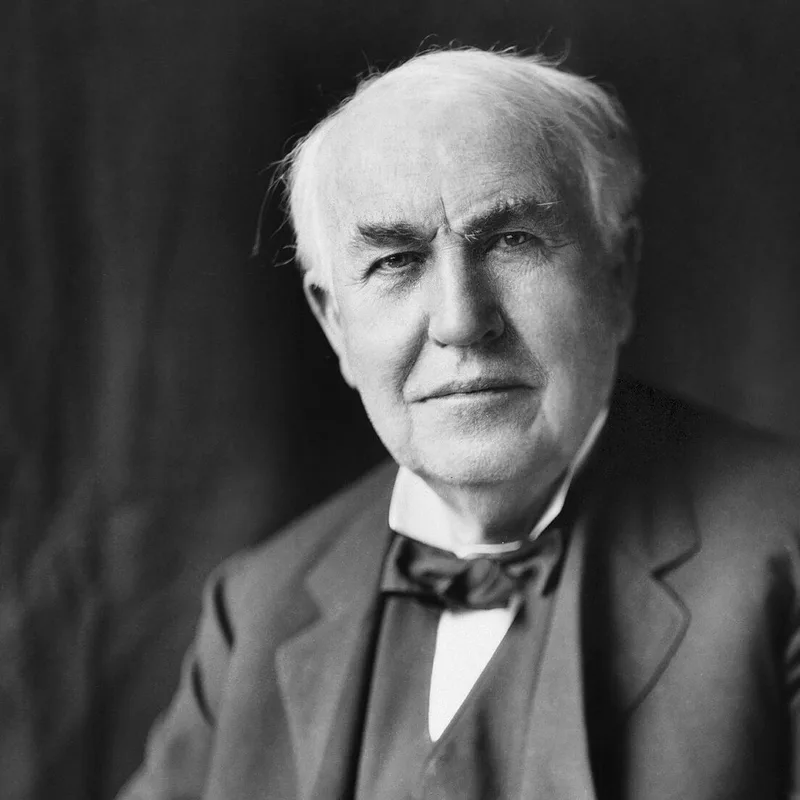
Thomas Edison
Inventor, Industrialist, 1847–1931
Deist
What is the meaning of life?
Work: draw out Nature's secrets and apply them for human happiness.
Edison never wrote out a philosophy of life; he said it was work. His biographer Francis Trevelyan Miller, who gathered his sayings in 1931, reports him constantly proclaiming that bringing out the secrets of nature and applying them for the happiness of man was the best service he knew of in the short time we are here. He did not count it as labor: he said he never did a day's work in his life because it was all fun. He also distrusted contentment, writing in his diary that discontent is the first necessity of progress and that a thoroughly satisfied man is a failure. Of conduct he asked only that a man hold honest convictions and live by them, and he liked to repeat Thomas Paine's line that his religion was to do good.
What is the meaning of the universe?
Nature did it all: a Supreme Intelligence, not the gods of religion.
In a 1910 interview with The New York Times, Edison said that nature is all we know, that it is neither kind nor merciful, and that nature, not the gods of the religions, made us; he denied that human beings have a soul or that anything of them survives death. The remarks got him called an atheist, which he rejected in a private letter: what you call God, he wrote, I call Nature, the Supreme Intelligence that rules matter. The frame came from Thomas Paine's Age of Reason, which he had read as a boy and defended all his life as a deism of nature rather than atheism. His view of what comes after softened with age. In the 1920s he said the evidence, such as it was, favored some kind of hereafter, and in a late letter he wrote simply that he believed in a Supreme Intelligence pervading the universe.
-
“Nature is what we know. We do not know the gods of religions. And nature is not kind, or merciful, or loving. If God made me — the fabled God of the three qualities of which I spoke: mercy, kindness, love — He also made the fish I catch and eat. And where do His mercy, kindness, and love for that fish come in? No; nature made us — nature did it all — not the gods of the religions”3
-
“You have misunderstood the whole article, because you jumped to the conclusion that it denies the existence of God. There is no such denial, what you call God I call Nature, the Supreme intelligence that rules matter. All the article states is that it is doubtful in my opinion if our intelligence or soul or whatever one may call it lives hereafter as an entity or disperses back again from whence it came, scattered amongst the cells of which we are made.”4
-
“I believe in the existence of a Supreme Intelligence pervading the Universe.”5