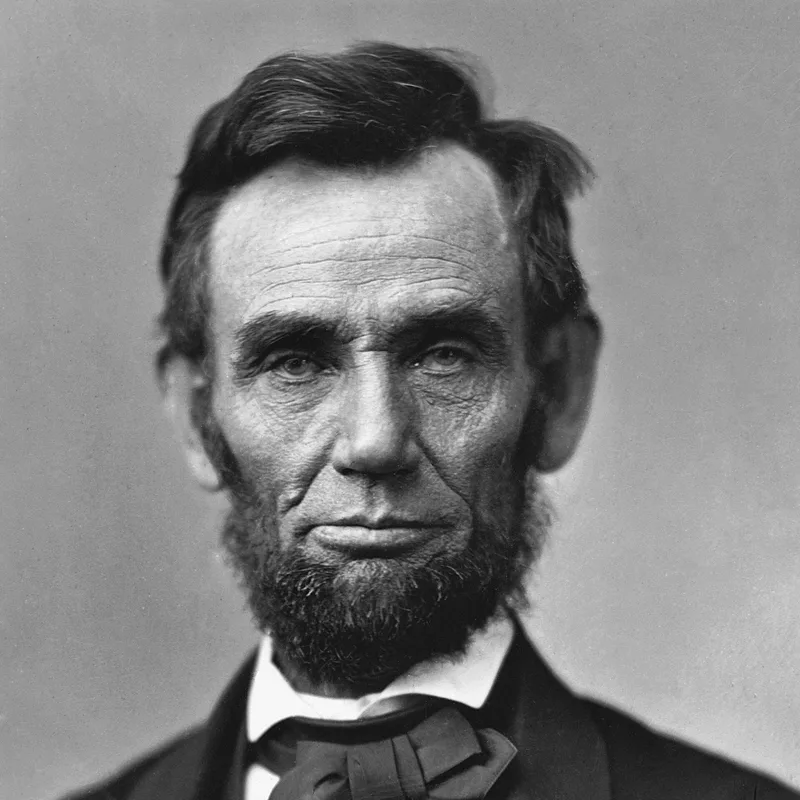
Abraham Lincoln
President of the United States, Lawyer, 1809–1865
Theist, never joined a church
What is the meaning of life?
To be truly esteemed, by rendering oneself worthy of esteem.
Lincoln rarely wrote about the purpose of life in general terms; what survives in his own words is personal. Announcing his first run for the Illinois legislature in 1832, at twenty-three, he wrote that he had no ambition so great as being truly esteemed by his fellow men, by making himself worthy of their esteem. He was prone to deep melancholy, and in 1842 he told his friend Joshua Speed that it was the peculiar misfortune of them both to dream dreams of Elysium beyond anything earthly could realize. As president, in December 1862, he wrote to Fanny McCullough, a young woman grieving for her father, that sorrow comes to all, but that she was sure to be happy again.
-
“Every man is said to have his peculiar ambition. Whether it be true or not, I can say, for one, that I have no other so great as that of being truly esteemed of my fellow-men, by rendering myself worthy of their esteem.”1
-
“I now have no doubt that it is the peculiar misfortune of both you and me to dream dreams of Elysium far exceeding all that anything earthly can realize.”2
-
“In this sad world of ours, sorrow comes to all; and, to the young, it comes with bitterest agony, because it takes them unawares. The older have learned to ever expect it. I am anxious to afford some alleviation of your present distress. Perfect relief is not possible, except with time. You can not now realize that you will ever feel better. Is not this so? And yet it is a mistake. You are sure to be happy again.”3
What is the meaning of the universe?
A God governing the world, whose purposes prevail.
As a young man Lincoln was a religious skeptic. In 1846, when the charge that he was an infidel was being whispered during his campaign for Congress, he answered in a handbill that he was not a member of any Christian church but had never denied the truth of the Scriptures, and that in early life he had believed in the "Doctrine of Necessity". After the death of his son Edward in 1850 he spoke more often of dependence on God; the next year he sent word to his dying father to trust in a merciful Maker and to expect a joyous meeting with loved ones gone before. He never joined a church. During the war his thought turned to providence: in a private note, later preserved by his secretary John Hay, he reasoned that God's purpose might differ from that of either side, and in 1865 he wrote that to deny a difference of purpose between the Almighty and men would be to deny that there is a God governing the world.
-
“It is true that in early life I was inclined to believe in what I understand is called the "Doctrine of Necessity"—that is, that the human mind is impelled to action, or held in rest by some power, over which the mind itself has no control; and I have sometimes (with one, two or three, but never publicly) tried to maintain this opinion in argument.”4
-
“Say to him that if we could meet now it is doubtful whether it would not be more painful than pleasant, but that if it be his lot to go now, he will soon have a joyous meeting with many loved ones gone before, and where the rest of us, through the help of God, hope ere long to join them.”5
-
“The will of God prevails. In great contests each party claims to act in accordance with the will of God. Both may be, and one must be, wrong. God cannot be for and against the same thing at the same time.”6
-
“Men are not flattered by being shown that there has been a difference of purpose between the Almighty and them. To deny it, however, in this case, is to deny that there is a God governing the world.”7