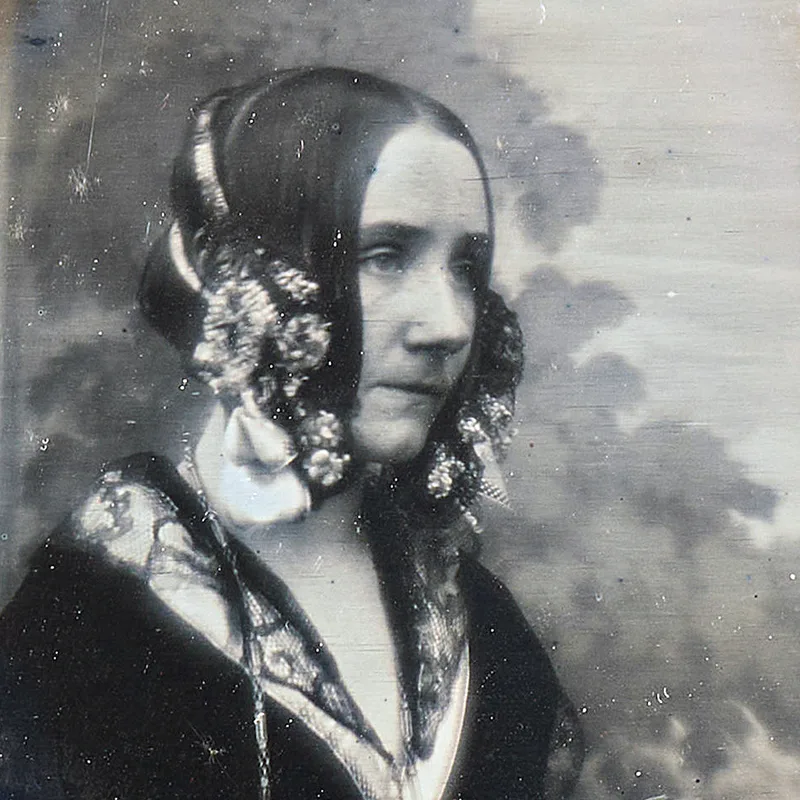
Ada Lovelace
Mathematician, Writer, 1815–1852
Science as reading God's works
What is the meaning of life?
Devote yourself, single-minded, to a great object: the bride of science.
Ada Lovelace was the only legitimate child of Lord Byron, who left the family when she was a baby; her mother had her schooled in mathematics partly to keep her away from her father's “poetical” temperament. Working with Charles Babbage on his never-built Analytical Engine, she published in 1843 a set of notes that included what is often called the first computer program, a method for calculating Bernoulli numbers, and foresaw that such a machine might one day compose music. Often ill, she spent long stretches of her short life in seclusion, which she accepted as the price of devotion: those with single minds devoted to any great object in life, she wrote to a friend, must find it at times inevitable; she was now more than ever the bride of science. She died of cancer at thirty-six.
-
“Circumstances have been such, that I have lived almost entirely secluded for some time. Those who are much in earnest and with single minds devoted to any great object in life, must find this occasionally inevitable.”1
-
“Perhaps you have felt already, from the tone of my letter, that I am more than ever now the bride of science.”1
What is the meaning of the universe?
Religion to me is science, and science is religion.
Lovelace saw no conflict between her mathematics and her faith; to her they were one activity. Science, she wrote to the electrical experimenter Andrew Crosse, was the reading of God's natural works, and reading them was reading God Himself, His will and His intelligence, and learning, as far as human power allows, to follow that will. She called her own way of thinking “poetical science”, and hoped that mathematics might one day reach even the workings of the mind and the nervous system.
-
“Religion to me is science, and science is religion. In that deeply-felt truth lies the secret of my intense devotion to the reading of God's natural works. It is reading Him. His will — His intelligence; and this again is learning to obey and to follow (to the best of our power) that will!”1