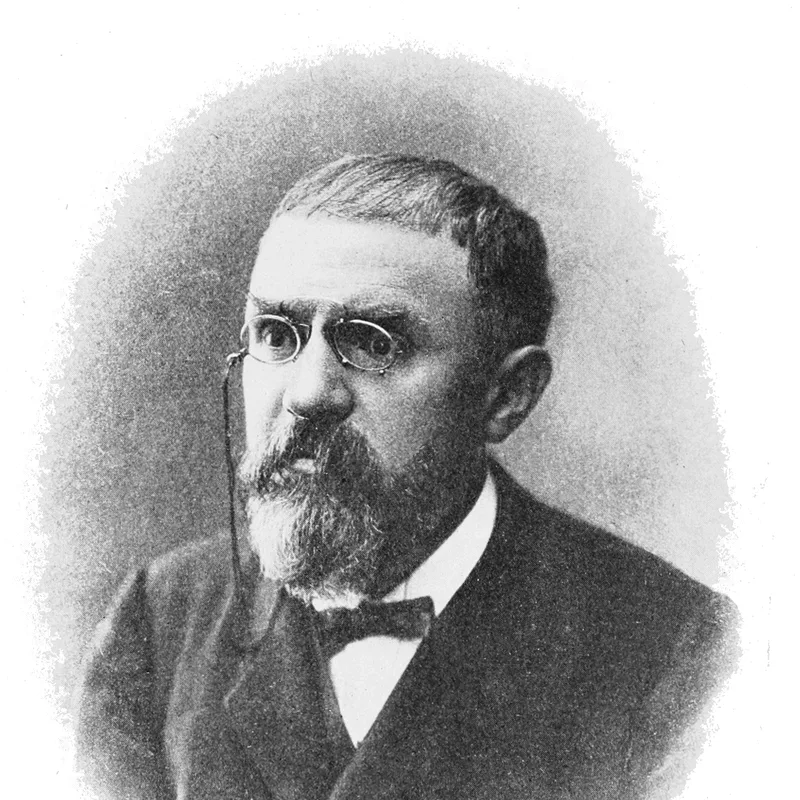
Henri Poincaré
Mathematician, Physicist, Philosopher of science, 1854–1912
Freethinker
What is the meaning of life?
If nature were not beautiful, life would not be worth living.
Poincaré was one of the last mathematicians to master the whole of his subject: he founded topology, found the first glimpses of chaos in the three-body problem of celestial mechanics, and came close to special relativity before Einstein. In his books for the general public he argued that science is not a collection of useful recipes. The scientist studies nature because he takes pleasure in it, and he takes pleasure in it because it is beautiful, not with the beauty of appearances, but with the deeper beauty of the harmonious order of its parts, which only the intelligence can grasp. If nature were not beautiful, he wrote, it would not be worth knowing, and life would not be worth living.
-
“The scientist does not study nature because it is useful to do so. He studies it because he takes pleasure in it, and he takes pleasure in it because it is beautiful. If nature were not beautiful it would not be worth knowing, and life would not be worth living.”1
What is the meaning of the universe?
Thought is a gleam in a long night; that gleam is everything.
Raised a Catholic, Poincaré gave up religious belief as a young man and became a freethinker. He was no crude materialist: in The Value of Science (1905) he argued that all we can ever know are relations, and that to say there is something other than thought is an affirmation without meaning. Yet geology shows, he went on, that life is only a short episode between two eternities of death, and that even within it conscious thought lasts only a moment, a gleam in the midst of a long night. But it is that gleam which is everything.
-
“…geologic history shows us that life is only a short episode between two eternities of death, and that, even in this episode, conscious thought has lasted and will last only a moment. Thought is only a gleam in the midst of a long night. But it is this gleam which is everything.”2