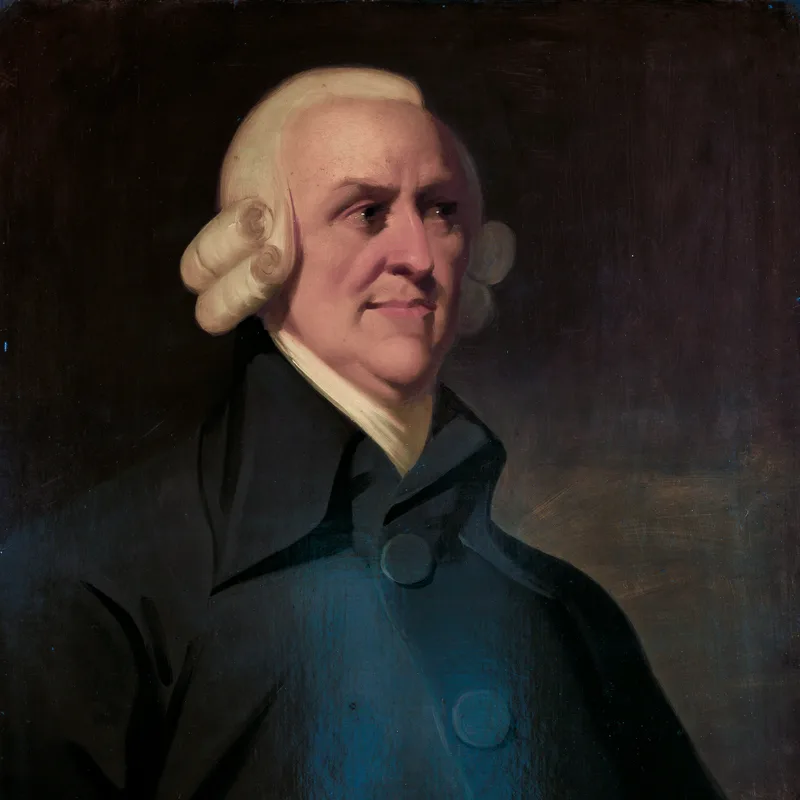
Adam Smith
Economist, Moral philosopher, 1723–1790
Deist, Stoic in temper
What is the meaning of life?
Care for your own, and find happiness in others' happiness.
Smith is remembered as the father of economics for The Wealth of Nations (1776), but he thought of himself first as a moral philosopher, and The Theory of Moral Sentiments (1759), which he kept revising until his death, opens not with self-interest but with sympathy. However selfish we may be, he wrote, there are principles in our nature that make the happiness of others necessary to us. Our task is a humble one: not to run the universe but to look after our own happiness and that of our family, friends and country, and to judge our conduct as an impartial spectator would.
-
“How selfish soever man may be supposed, there are evidently some principles in his nature, which interest him in the fortune of others, and render their happiness necessary to him, though he derives nothing from it, except the pleasure of seeing it.”1
-
“To man is allotted a much humbler department, but one much more suitable to the weakness of his powers, and to the narrowness of his comprehension; the care of his own happiness, of that of his family, his friends, his country…”2
What is the meaning of the universe?
The universe is God's to run; ours is the humbler part.
Smith's universe is a great, orderly system in which every part is fitted to its end, like a well-made machine, and behind it stands a benevolent Author of nature who has arranged even human feelings so that they serve the common good, the same invisible hand that appears in The Wealth of Nations. He rarely spoke of revelation, and his friendship with the sceptic David Hume, whose calm and cheerful death he described with open admiration, scandalised the pious. The administration of the great system of the universe, he wrote, is the business of God and not of man.
-
“In every part of the universe we observe means adjusted with the nicest artifice to the ends which they are intended to produce…”3
-
“The administration of the great system of the universe, however, the care of the universal happiness of all rational and sensible beings, is the business of God and not of man.”2