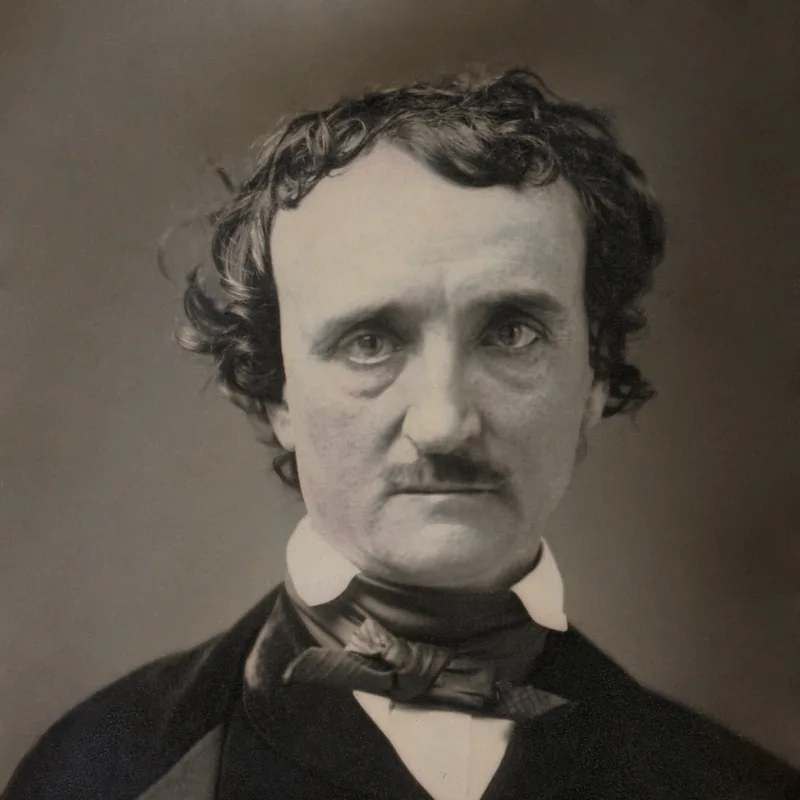
Edgar Allan Poe
Poet, Writer, 1809–1849
Cosmic pantheist
What is the meaning of life?
Everything we see or seem may be a dream within a dream.
Poe was orphaned at two, raised by a Richmond merchant with whom he later fell out, and lived most of his life in poverty while inventing the detective story and writing some of the best-known tales of horror and poems in English. His wife Virginia died of tuberculosis in 1847, and he died two years later in Baltimore in circumstances that are still unexplained. In “A Dream Within a Dream”, published in the year of his death, the speaker watches grains of sand slip through his fingers and asks whether everything we see or seem is only a dream within a dream.
-
“Yet if hope has flown away / In a night, or in a day, / In a vision or in none, / Is it therefore the less gone? / All that we see or seem / Is but a dream within a dream.”1
What is the meaning of the universe?
The universe is God's plot; God is diffused through it.
In Eureka (1848), a long prose poem he considered his greatest work, Poe set out his own cosmology. The universe began from a single primordial particle, spread outward, and will one day collapse back into unity, a sketch some later readers compared with the Big Bang. God, in his account, now exists only in the diffused matter and spirit of the universe, and the regathering of everything will restore the single, spiritual God. The plots of God are perfect, he wrote, and the universe is one of them.
-
“The plots of God are perfect. The Universe is a plot of God.”2
-
“…God—the material and spiritual God—now exists solely in the diffused Matter and Spirit of the Universe; and that the regathering of this diffused Matter and Spirit will be but the re-constitution of the purely Spiritual and Individual God.”2