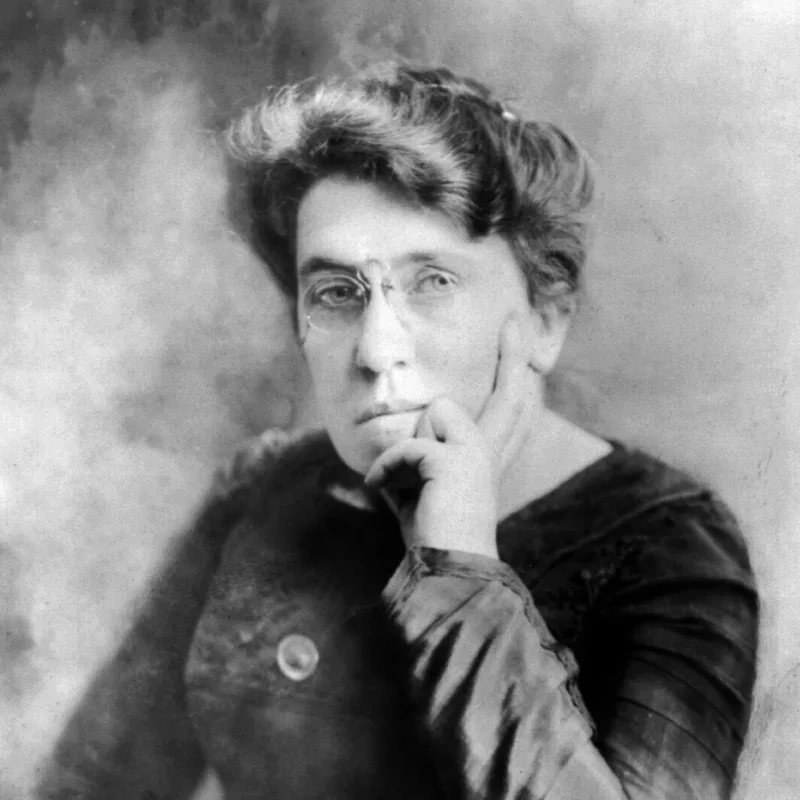
Emma Goldman
Anarchist, Activist, Writer, 1869–1940
Anarchist, atheist
What is the meaning of life?
Freedom, self-expression, and everyone's right to beautiful things.
Goldman was born in Kovno, in the Russian Empire, emigrated to the United States at sixteen, and became the best-known anarchist speaker in America, lecturing on free speech, birth control, the freedom of women and the rights of workers until she was deported to Russia in 1919. For her the point of a life was to live it freely: every institution that forced people into work they hated, marriages they had not chosen or beliefs they did not hold was robbing them of their lives. In her autobiography she remembered a young comrade telling her that it did not become an agitator to dance; she answered that a cause standing for freedom could not demand the denial of life and joy. The struggle for liberty, she wrote, mattered as much as winning it, because it brought out what was finest in people.
-
“I want freedom, the right to self-expression, everybody's right to beautiful, radiant things.”1
-
“In the battle for freedom, as Ibsen has so well pointed out, it is the struggle for, not so much the attainment of, liberty, that develops all that is strongest, sturdiest and finest in human character.”2
What is the meaning of the universe?
No gods and no beyond; the earth is the only heaven.
Goldman grew up in a Jewish family in the Russian Empire and gave up religion early. In “The Philosophy of Atheism”, written for her magazine Mother Earth in 1916, she argued that belief in God had kept people bowed under fear and obedience, and that atheism was not only a denial but an affirmation: of the real, visible world and of the human power to make it better. Only when people stopped looking to heaven, she wrote, would they build a new world on earth. Asked about God after a lecture in Detroit in 1898, she said she did not believe in God because she believed in man.
-
“The philosophy of Atheism represents a concept of life without any metaphysical Beyond or Divine Regulator. It is the concept of an actual, real world with its liberating, expanding and beautifying possibilities, as against an unreal world, which, with its spirits, oracles, and mean contentment has kept humanity in helpless degradation.”3
-
“The triumph of the philosophy of Atheism is to free man from the nightmare of gods; it means the dissolution of the phantoms of the beyond.”3
-
“Beauty as a gift from heaven has proved useless. It will, however, become the essence and impetus of life when man learns to see in the earth the only heaven fit for man.”3