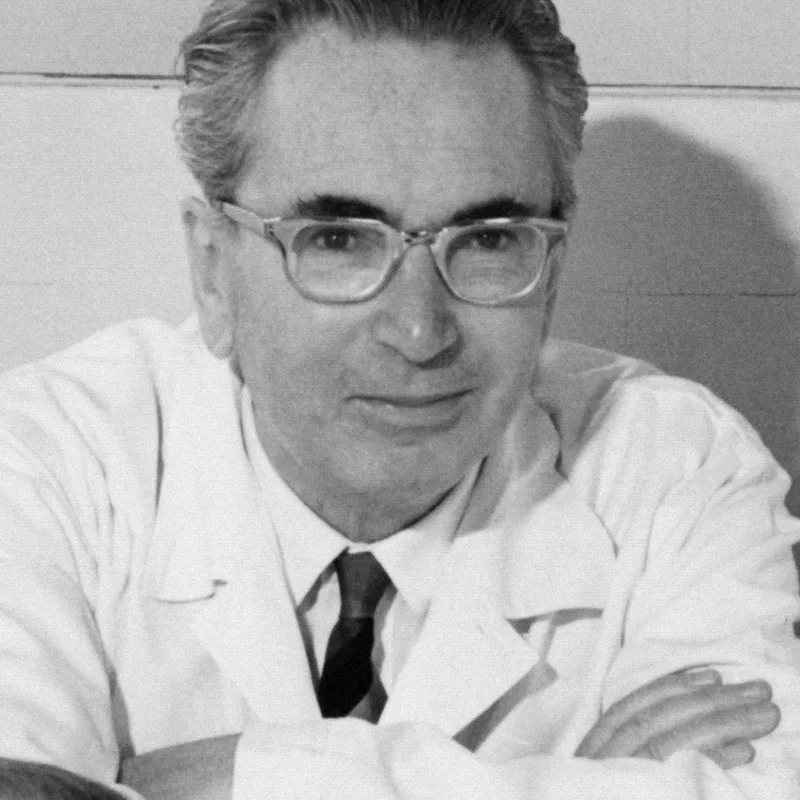
Viktor Frankl
Psychiatrist, Neurologist, Holocaust survivor, 1905–1997
Theist
What is the meaning of life?
To answer what life asks of you — through work, love, suffering.
Frankl built logotherapy on one claim: the main drive in a person is not pleasure, as Freud held, or power, as Adler held, but the will to meaning. Meaning is not invented but found, and it differs from person to person and hour to hour, so he turned the question around — life asks each of us, and we answer by taking responsibility for a concrete task. He named three routes: creating a work or doing a deed, experiencing something or loving someone, and the attitude one takes toward suffering that cannot be avoided. His three years in Theresienstadt, Auschwitz and the Dachau subcamps became the test case for the theory in Man's Search for Meaning (1946). He added that suffering is not required for meaning; if it can be removed, the meaningful act is to remove it.
-
“Ultimately, man should not ask what the meaning of his life is, but rather must recognize that it is he who is asked. In a word, each man is questioned by life; and he can only answer to life by answering for his own life; to life he can only respond by being responsible.”1
-
“What man actually needs is not a tensionless state but rather the striving and struggling for some goal worthy of him. What he needs is not the discharge of tension at any cost, but the call of a potential meaning waiting to be fulfilled by him.”2
-
“A thought transfixed me: for the first time in my life I saw the truth as it is set into song by so many poets, proclaimed as the final wisdom by so many thinkers. The truth — that love is the ultimate and the highest goal to which man can aspire. Then I grasped the meaning of the greatest secret that human poetry and human thought and belief have to impart: The salvation of man is through love and in love.”1
-
“If there is a meaning in life at all, then there must be a meaning in suffering. Suffering is an ineradicable part of life, even as fate and death.”1
What is the meaning of the universe?
A world beyond man's, holding a meaning we can't grasp.
Frankl kept his own faith mostly private; his family said after his death that he had prayed every day. His books point past the human world. In Man's Search for Meaning he asks whether humanity is really the end point of the cosmos, and suggests another dimension in which the ultimate meaning of suffering would find its answer — a super-meaning that exceeds the intellect, so that the task is to bear our inability to grasp it rather than to call life meaningless. His 1948 dissertation The Unconscious God, reworked late in life as Man's Search for Ultimate Meaning (1997), argued that people carry a hidden, personal relation to a hidden God — not an impersonal force, which is where he thought Jung went wrong — and offered a definition he said he had formed at fifteen: God is the one you address when you speak to yourself in complete sincerity. He held that belief in God is either unconditional, able to face the six million dead, or not belief at all.
-
“This ultimate meaning necessarily exceeds and surpasses the finite intellectual capacities of man; in logotherapy, we speak in this context of a super-meaning. What is demanded of man is not, as some existential philosophers teach, to endure the meaninglessness of life, but rather to bear his incapacity to grasp its unconditional meaningfulness in rational terms. Logos is deeper than logic.”3
-
“It cannot be emphasized strongly enough that not only is the unconscious neither divine nor omniscient, but above all man's unconscious relation to God is profoundly personal. The "unconscious God" must not be mistaken as an impersonal force operant in man.”4
-
“God is the partner of our most intimate soliloquies.”5
-
“faith in the ultimate meaning is preceded by trust in an ultimate being”6