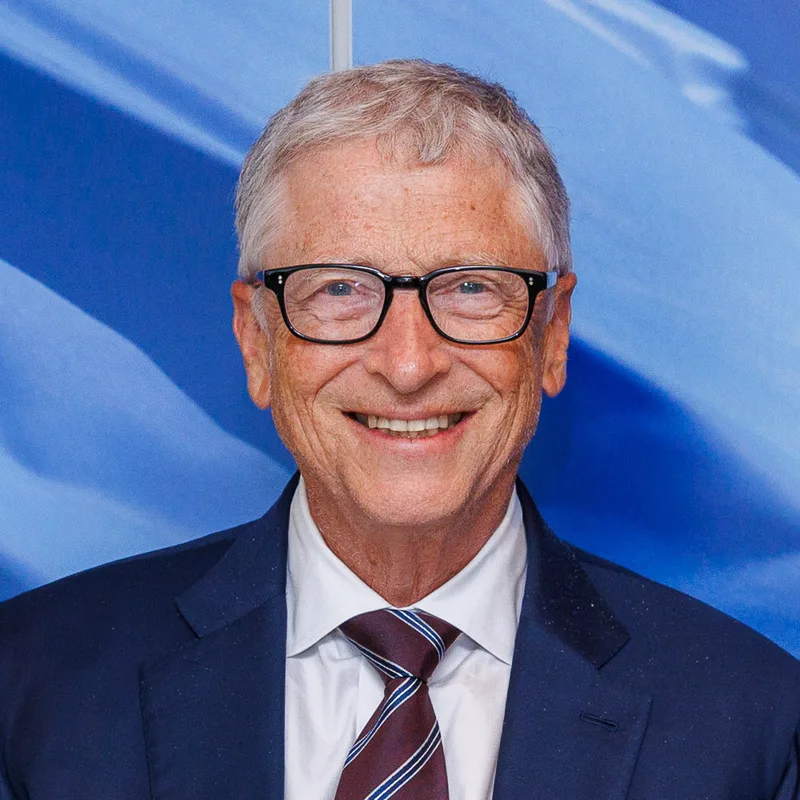
Bill Gates
Co-founder of Microsoft, Philanthropist, born 1955
Agnostic
What is the meaning of life?
Reducing inequity — from those given much, much is expected.
Gates' answer is moral rather than metaphysical. In his 2007 Harvard commencement address he said that humanity's greatest advances are not its discoveries but how they are applied to reduce inequity, and he asked the graduates to judge themselves by how they treated people a world away. He traced the impulse to his mother, who closed a letter to his future wife with the line that from those to whom much is given, much is expected. In 2014 he called the moral systems of religion very important and said that his own luck obliged him to work on inequity — a religious belief, he said, or at least a moral one.
-
“But humanity's greatest advances are not in its discoveries – but in how those discoveries are applied to reduce inequity. Whether through democracy, strong public education, quality health care, or broad economic opportunity – reducing inequity is the highest human achievement.”1
-
“I hope you will judge yourselves not on your professional accomplishments alone, but also on how well you have addressed the world's deepest inequities … on how well you treated people a world away who have nothing in common with you but their humanity.”1
-
“The moral systems of religion, I think, are superimportant. We've raised our kids in a religious way; they've gone to the Catholic church that Melinda goes to and I participate in. I've been very lucky, and therefore I owe it to try and reduce the inequity in the world. And that's kind of a religious belief. I mean, it's at least a moral belief.”2
What is the meaning of the universe?
Don't know if there's a God; believing makes sense.
Gates takes what he calls a scientific approach to why things happen, and for most of his life he declined to say whether there is a God. In 1995 he said he did not know, and in 1997 he remarked that religion was not an efficient use of a Sunday morning. By 2014, with his children raised in his wife's Catholic church, he agreed with Richard Dawkins that creation myths were early substitutes for science, but added that the mystery and beauty of the world has no scientific explanation and that calling it the product of random numbers seemed uncharitable. He concluded that it makes sense to believe in God, while admitting he did not know what he would do differently because of it.
-
“I agree with people like Richard Dawkins that mankind felt the need for creation myths. … Now science has filled in some of the realm – not all – that religion used to fill. But the mystery and the beauty of the world is overwhelmingly amazing, and there's no scientific explanation of how it came about. To say that it was generated by random numbers, that does seem, you know, sort of an uncharitable view. I think it makes sense to believe in God, but exactly what decision in your life you make differently because of it, I don't know.”3
-
“In terms of doing things I take a fairly scientific approach to why things happen and how they happen. I don't know if there's a god or not, but I think religious principles are quite valid.”4
-
“Just in terms of allocation of time resources, religion is not very efficient. There's a lot more I could be doing on a Sunday morning.”5