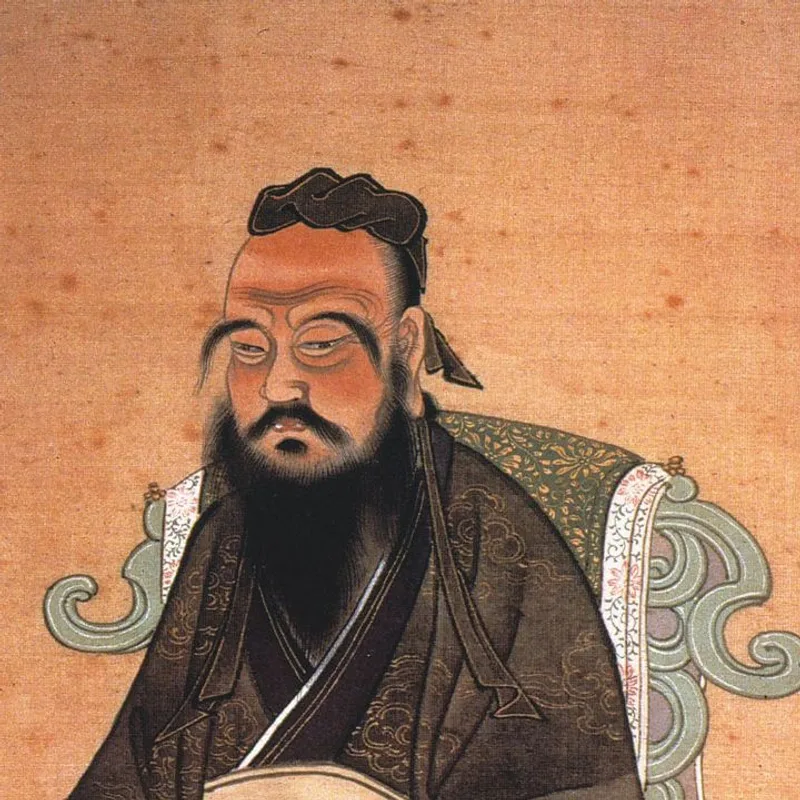
Confucius
Philosopher, Teacher, c. 551 – 479 BC
Confucian humanist
What is the meaning of life?
To learn, to love others, and to follow the Way.
Confucius taught in the state of Lu in the sixth and fifth centuries BC; the Analects, sayings collected by his followers and largely composed in the Warring States period, are the main record of what he said. The good life, for him, is one of self-cultivation through learning, aimed at becoming a junzi, the "superior man" of Legge's translation. Its centre is ren, which Legge renders as benevolence or perfect virtue: to love others, and never to do to them what you would not want done to yourself. He described his own life as a slow ascent — set on learning at fifteen, knowing the decrees of Heaven at fifty, following his heart at seventy without overstepping what is right — and said that a man who hears the Way in the morning can die in the evening without regret.
-
“Fan Ch'ih asked about benevolence. The Master said, 'It is to love all men.' He asked about knowledge. The Master said, 'It is to know all men.'”1
-
“Tsze-kung asked, saying, 'Is there one word which may serve as a rule of practice for all one's life?' The Master said, 'Is not RECIPROCITY such a word? What you do not want done to yourself, do not do to others.'”2
-
“At fifteen, I had my mind bent on learning. At thirty, I stood firm. At forty, I had no doubts. At fifty, I knew the decrees of Heaven. At sixty, my ear was an obedient organ for the reception of truth. At seventy, I could follow what my heart desired, without transgressing what was right.”3
-
“If a man in the morning hear the right way, he may die in the evening without regret.”4
What is the meaning of the universe?
Heaven, which does not speak; know life before asking about death.
Confucius said little about what lies behind the world, and his disciples noticed: extraordinary things and spiritual beings were subjects he did not talk about, and his views on the way of Heaven could not be heard. He did not deny the spirits — he took part in the sacrifices — but he advised respecting them while keeping one's distance, and he turned questions about the dead back to the living: first learn to serve people, first understand life. Heaven (tian) is the one power he names: it gave him his virtue, it knows him when no one else does, and it does not speak — the seasons simply run their course and all things are produced. Scholars describe him as more of a humanist than a spiritualist, and his views on Heaven and the afterlife as left indeterminate.
-
“Chi Lu asked about serving the spirits of the dead. The Master said, 'While you are not able to serve men, how can you serve their spirits?' Chi Lu added, 'I venture to ask about death?' He was answered, 'While you do not know life, how can you know about death?'”5
-
“To give one's self earnestly to the duties due to men, and, while respecting spiritual beings, to keep aloof from them, may be called wisdom.”6
-
“Does Heaven speak? The four seasons pursue their courses, and all things are continually being produced, but does Heaven say anything?”7
-
“I do not murmur against Heaven. I do not grumble against men. My studies lie low, and my penetration rises high. But there is Heaven;—that knows me!”8