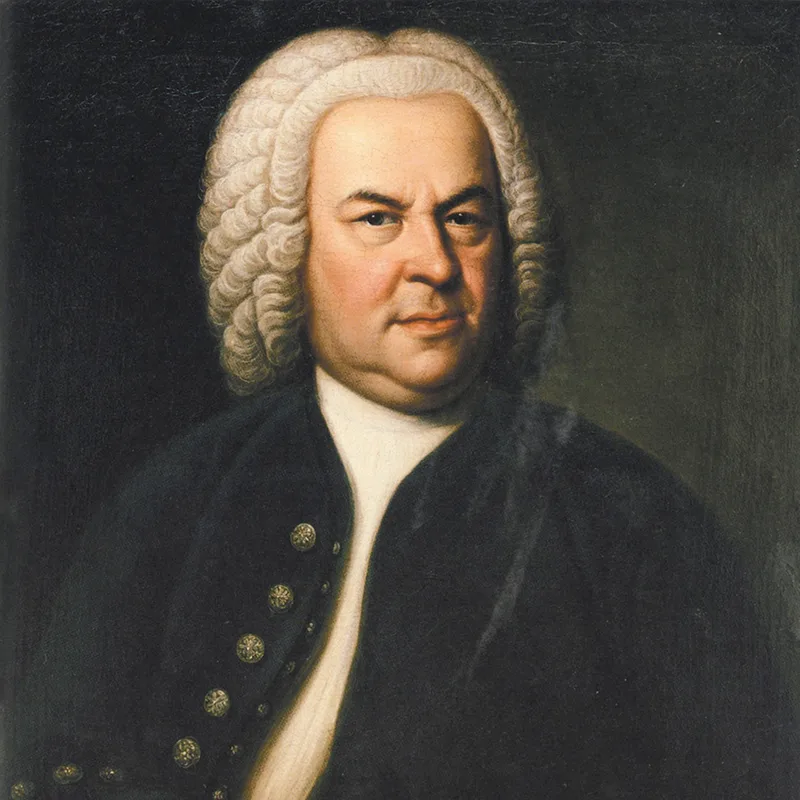
Johann Sebastian Bach
Composer, Organist, 1685–1750
Lutheran
What is the meaning of life?
To glorify God, refresh the soul, and teach the neighbour.
Bach left almost no writing about himself, so his answer has to be read off his working habits. He headed his scores J.J. — Jesu juva, Jesus, help — and closed them S.D.G., soli Deo gloria, to God alone the glory. He put the same idea on the title page of the Orgelbüchlein, and in 1738 dictated it to his pupils as a rule: music, like everything else, exists for the glory of God and the refreshment of the soul. Both halves echo Luther's teaching on vocation: honest work is service to God and to one's neighbour. Bach treated his trade as that service, and does not seem to have separated the purpose of his life from the purpose of his music.
-
“Like all music, the figured bass should have no other end and aim than the glory of God and the recreation of the soul; where this is not kept in mind there is no true music, but only an infernal clamour and ranting.”1
-
“To the glory of the most high God alone, and that my neighbour may be educated thereby.”2
What is the meaning of the universe?
The God of Luther's Bible, present wherever devotional music sounds.
Bach was an orthodox Lutheran from a Lutheran heartland. He studied theology at school and later taught Luther's Small Catechism in Leipzig. He never discussed God in the abstract; what survives are the marginal notes in his three-volume Calov Bible — Luther's translation with commentary — which he signed in 1733. Beside the passages on the temple musicians he wrote that music itself had been ordained by God's Spirit, and that where devotional music is played, God is present with his grace. For Bach the world was the creation of the God of Scripture, and music was one of the places where that God could be met.