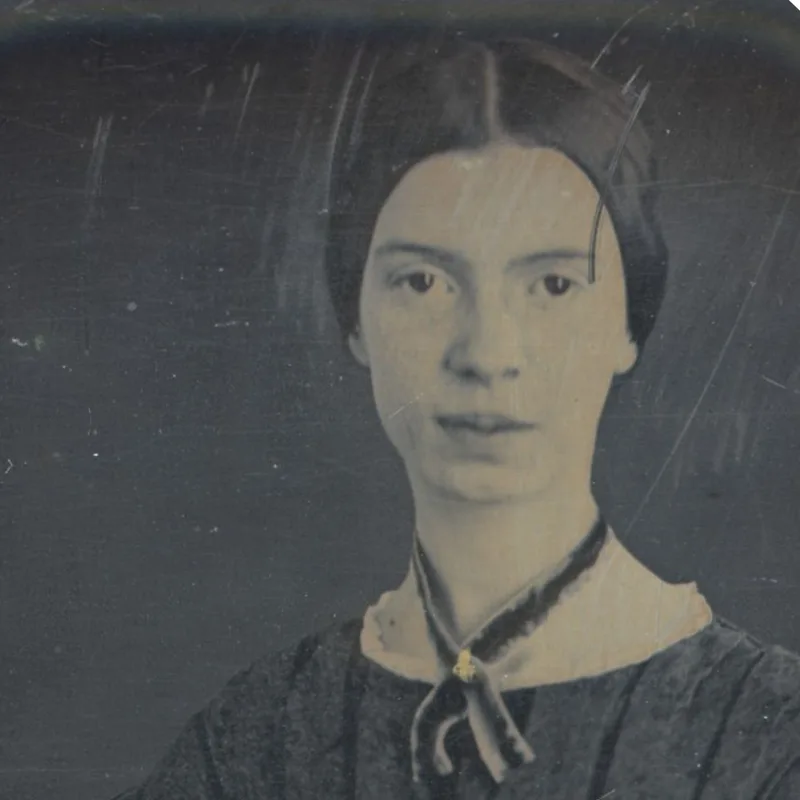
Emily Dickinson
Poet, 1830–1886
Unchurched believer
What is the meaning of life?
Not to live in vain: to ease one pain, one heart.
Emily Dickinson spent almost all her life in her family's house in Amherst, Massachusetts, and wrote nearly 1,800 poems, only about ten of which were published while she lived. Her poems keep returning to death, eternity and the small things of a garden or a household. One of the best known, printed in the first collection after her death, measures a life by whether it eased someone else's pain. It asks for nothing grander than one heart kept from breaking, or one robin helped back to its nest.
-
“If I can stop one heart from breaking, / I shall not live in vain; / If I can ease one life the aching, / Or cool one pain, / Or help one fainting robin / Unto his nest again, / I shall not live in vain.”1
What is the meaning of the universe?
Heaven is certain, though unseen; God preaches in the orchard.
As a student at Mount Holyoke Female Seminary, Dickinson would not stand up to declare herself a Christian, and in her thirties she stopped going to church altogether. Her poems treat God, heaven and immortality with a mixture of certainty, doubt and irony. In one she is as sure of heaven as of a moor she has never seen. In another she keeps the Sabbath at home, with birds for a choir and an orchard for a dome, and God himself as the preacher.
-
“I never saw a moor, / I never saw the sea; / Yet know I how the heather looks, / And what a wave must be. / I never spoke with God, / Nor visited in heaven; / Yet certain am I of the spot / As if the chart were given.”1
-
“Some keep the Sabbath going to church; / I keep it staying at home, / With a bobolink for a chorister, / And an orchard for a dome. … God preaches,—a noted clergyman,— / And the sermon is never long; / So instead of getting to heaven at last, / I'm going all along!”2