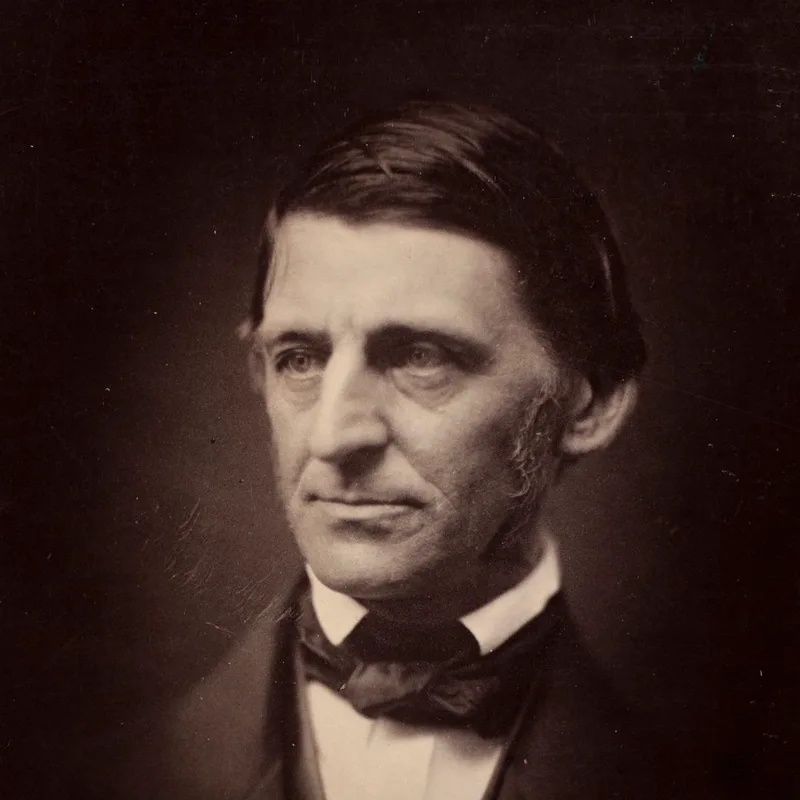
Ralph Waldo Emerson
Essayist, Poet, Lecturer, 1803–1882
Transcendentalist
What is the meaning of life?
Trust yourself, finish the moment, live the most good hours.
Emerson resigned as a Unitarian minister in 1832, unable in conscience to go on serving communion, and became a lecturer and essayist instead. His ethic is self-reliance: trust your own intuition, which is the divine speaking in you, over custom, creeds and the opinions of others. In the essay Experience, written after the death of his five-year-old son, he reached a quieter wisdom. It was to take each moment as complete in itself and to live as many good hours as possible.
-
“Trust thyself: every heart vibrates to that iron string. Accept the place the divine providence has found for you, the society of your contemporaries, the connection of events.”1
-
“To finish the moment, to find the journey's end in every step of the road, to live the greatest number of good hours, is wisdom.”2
What is the meaning of the universe?
One Over-Soul in all things; in nature I am part of God.
In Nature (1836), the short book that launched American transcendentalism, Emerson described crossing a bare common at twilight and feeling the currents of a universal being pass through him. He called that being the Over-Soul: a single mind or spirit of which every person and every natural fact is a part. God, for him, is not a person outside the world who revealed himself once, but something present now, in nature and in each soul. His 1838 address to the graduates of Harvard Divinity School said so, and Harvard did not invite him back for nearly thirty years.
-
“Standing on the bare ground,—my head bathed by the blithe air, and uplifted into infinite space,—all mean egotism vanishes. I become a transparent eye-ball; I am nothing; I see all; the currents of the Universal Being circulate through me; I am part or particle of God.”3
-
“Meantime within man is the soul of the whole; the wise silence; the universal beauty, to which every part and particle is equally related; the eternal ONE.”4