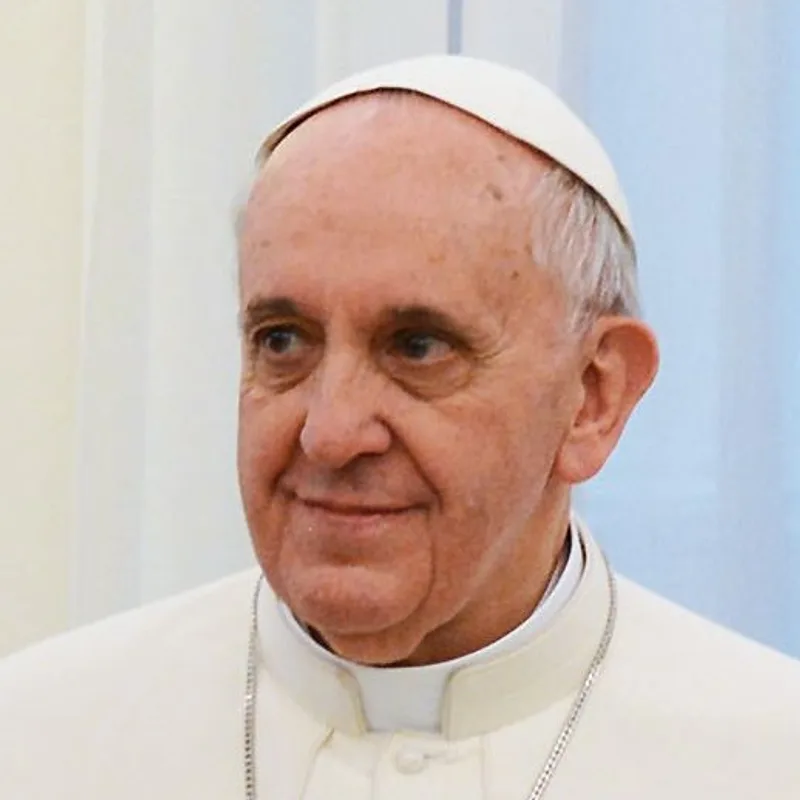
Pope Francis
Pope, Jesuit priest, 1936–2025
Catholic
What is the meaning of life?
Life is a gift; love is its source and its meaning.
Jorge Mario Bergoglio, an Argentine Jesuit who became pope in 2013, answered as a pastor. In Evangelii Gaudium (2013), the first major document of his pontificate, he wrote that the encounter with God's love frees people from narrowness and self-absorption, and that we become fully human only when we let God bring us beyond ourselves. In a video message to the TED conference in Vancouver in 2017 he said that years of life had convinced him that every existence is tied to the existence of others — life is not time passing but interaction — and that love is the source and the meaning of life. At World Youth Day in Kraków in 2016 he warned young people against "sofa-happiness", comfort mistaken for happiness, and told them they had come into the world to leave a mark.
-
“Quite a few years of life have strengthened my conviction that each and everyone's existence is deeply tied to that of others: life is not time merely passing by, life is about interactions.”1
-
“When one realizes that life, even in the middle of so many contradictions, is a gift, that love is the source and the meaning of life, how can they withhold their urge to do good to another fellow being?”1
-
“Thanks solely to this encounter – or renewed encounter – with God's love, which blossoms into an enriching friendship, we are liberated from our narrowness and self-absorption. We become fully human when we become more than human, when we let God bring us beyond ourselves in order to attain the fullest truth of our being.”2
What is the meaning of the universe?
A creation of love, not chance — Big Bang and evolution included.
Francis held the Catholic doctrine of creation: the world exists because God freely chose to make it, out of love. He also held that this doctrine does not compete with science. Addressing the Pontifical Academy of Sciences in October 2014, he said that God is not a magician with a magic wand: he created beings and let them develop by the internal laws he gave them, so that the Big Bang does not contradict a divine creator but depends on one, and evolution presupposes beings created to evolve. In Laudato si' (2015), his encyclical on care for the environment, he wrote that the universe came from a decision, not from chaos or chance, that creation is of the order of love, and that its ultimate destiny is the fullness of God.
-
“When we read the account of Creation in Genesis we risk imagining that God was a magician, complete with an all powerful magic wand. But that was not so. He created beings and he let them develop according to the internal laws with which He endowed each one, that they might develop, and reach their fullness.”3
-
“The beginning of the world was not a work of chaos that owes its origin to another, but derives directly from a supreme Principle who creates out of love. The Big Bang theory, which is proposed today as the origin of the world, does not contradict the intervention of a divine creator but depends on it. Evolution in nature does not conflict with the notion of Creation, because evolution presupposes the creation of beings who evolve.”3
-
“This tells us that the world came about as the result of a decision, not from chaos or chance, and this exalts it all the more. The creating word expresses a free choice. The universe did not emerge as the result of arbitrary omnipotence, a show of force or a desire for self-assertion. Creation is of the order of love.”4