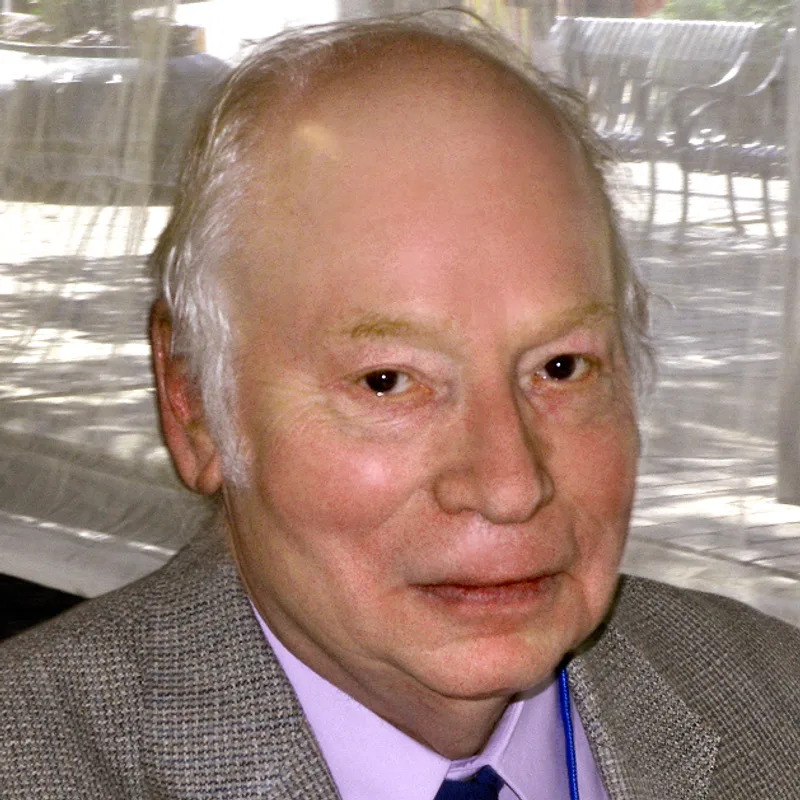
Steven Weinberg
Theoretical physicist, 1933–2021
Atheist
What is the meaning of life?
No given point; we make one with love, science and art.
The epilogue of The First Three Minutes (1977) contains the sentence that made Weinberg famous outside physics: the more the universe seems comprehensible, the more it also seems pointless. He meant that science finds no plan in which humans play a starring role. He always pointed to what follows it, which readers tended to skip: the effort to understand the universe is one of the very few things that lifts human life a little above the level of farce. Two decades later, in a 1998 interview, he added that if the universe gives us no point, we can give it one by the way we live — by loving each other, by discovering things about nature, by making works of art. He called this a melancholy view, and said melancholy has its own consolations.
-
“The effort to understand the universe is one of the very few things that lifts human life a little above the level of farce, and gives it some of the grace of tragedy.”1
-
“If there is no point in the universe that we discover by the methods of science, there is a point that we can give the universe by the way we live, by loving each other, by discovering things about nature, by creating works of art. … it is not entirely ignoble that faced with this unloving, impersonal universe we make a little island of warmth and love and science and art for ourselves.”2
-
“It seems to me that we are in the position of a company of players who have by chance found their way into a great theater. … However, no scripts are found, so the players begin to improvise—a little psychological drama, a little poetry, whatever comes to mind. Some even set themselves to explain the stage machinery. The players do not forget that they are just amusing themselves, and that they will have to return to the darkness outside the theater, but while on the stage they do their best to give a good performance.”3
What is the meaning of the universe?
Comprehensible, impersonal, pointless — and no designer in sight.
Weinberg found no sign of a designer. The final laws of nature, as far as physics can see them, are impersonal and give no special role to life; humans appear as a chance outcome, not the goal the universe is aimed at. He thought the fine-tuning arguments weak and the evidence of suffering strong — in his own family's history he saw few signs of a benevolent designer. He objected to the loose use of the word God for the laws of nature: historically the word has meant an interested personality, and that is not what science finds. He was blunt about religion's moral record, and called the god of traditional Judaism, Christianity and Islam a terrible character.
-
“It is almost irresistible for humans to believe that we have some special relation to the universe, that human life is not just a more-or-less farcical outcome of a chain of accidents reaching back to the first three minutes, but that we were somehow built in from the beginning. … It is very hard to realize that this all is just a tiny part of an overwhelmingly hostile universe. … The more the universe seems comprehensible, the more it also seems pointless.”1
-
“I'd guess that if we were to see the hand of the designer anywhere, it would be in the fundamental principles, the final laws of nature, the book of rules that govern all natural phenomena. We don't know the final laws yet, but as far as we have been able to see, they are utterly impersonal and quite without any special role for life. There is no life force.”4
-
“My life has been remarkably happy, perhaps in the upper 99.99 percentile of human happiness, but even so, I have seen a mother die painfully of cancer, a father's personality destroyed by Alzheimer's disease, and scores of second and third cousins murdered in the Holocaust. Signs of a benevolent designer are pretty well hidden.”5
-
“With or without religion, good people can behave well and bad people can do evil; but for good people to do evil — that takes religion.”5