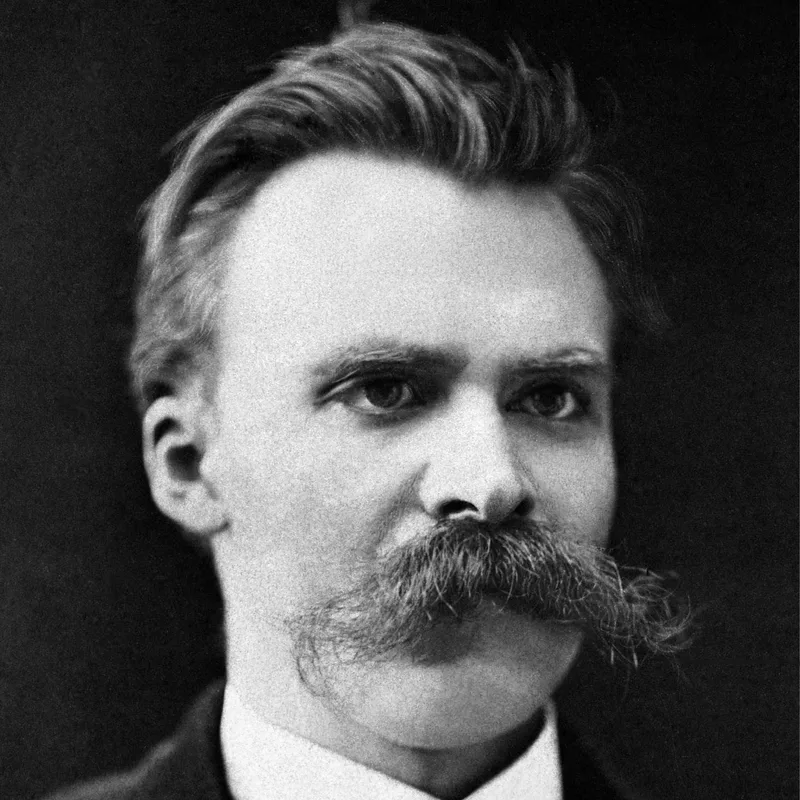
Friedrich Nietzsche
Philosopher, Philologist, 1844–1900
Atheist
What is the meaning of life?
No given meaning: stay true to the earth, and love your fate.
Nietzsche started from the collapse of the old answer: with Christian belief gone, Europe faced nihilism, the sense that nothing is worth anything. His reply was a stance rather than a doctrine. In Thus Spoke Zarathustra the meaning of life is placed on the earth, not beyond it, and the Overman is the human type that creates its own values. His test for a life was the eternal recurrence — could you will this life again, unchanged, forever? Late in his work he named the attitude amor fati, love of fate, and Twilight of the Idols gives the practical version in one line: whoever has a why can bear almost any how.
-
“He who has a Why? in life can tolerate almost any How?”1
-
“The Superman is the meaning of the earth. Let your will say: The Superman shall be the meaning of the earth! I conjure you, my brethren, remain true to the earth, and believe not those who speak unto you of superearthly hopes! Poisoners are they, whether they know it or not.”2
-
“What, if some day or night, a demon were to steal after you into your loneliest loneliness and say to you: 'This life, as you now live it and have lived it, you will have to live once more and innumerable times more; and there will be nothing new in it … Or how well disposed would you have to become to yourself and to life to crave nothing more fervently than this ultimate eternal confirmation and seal?”3
-
“My formula for the greatness of a human being is amor fati: that one wants nothing to be different—not forward, not backward, not in all eternity. Not merely to bear what is necessary, still less conceal it … but love it.”4
What is the meaning of the universe?
God is dead; the world is chaos and necessity, nothing behind it.
Nietzsche's "God is dead" is not an argument for atheism but a report: belief in the Christian God had become unbelievable, and Europe had not yet felt the consequences. What is left is a world with nothing behind it. In The Gay Science he describes the universe as chaos to all eternity — without order, purpose or laws, only necessities, with no one commanding and no one obeying — and warns against the "shadows of God", the habit of reading design, machinery or moral meaning back into nature. His own positive hypothesis, in Beyond Good and Evil, was that the world seen from inside is will to power and nothing else. He admitted that this too was an interpretation, which for him was the point: there is no view from nowhere, only perspectives.
-
“God is dead! God remains dead! And we have killed him. How shall we comfort ourselves, the murderers of all murderers? What was holiest and mightiest of all that the world has yet owned has bled to death under our knives: who will wipe this blood off us?”5
-
“God is dead; but given the way of men, there may still be caves for thousands of years in which his shadow will be shown. — And we — we still have to vanquish his shadow, too.”6
-
“The general character of the world, on the other hand, is to all eternity chaos; not by the absence of necessity, but in the sense of the absence of order, structure, form, beauty, wisdom, and whatever else our æsthetic humanities are called. … Let us be on our guard against saying that there are laws in nature. There are only necessities: there is no one who commands, no one who obeys, no one who transgresses.”7
-
“The world seen from within, the world defined and designated according to its "intelligible character"—it would simply be "Will to Power," and nothing else.”8