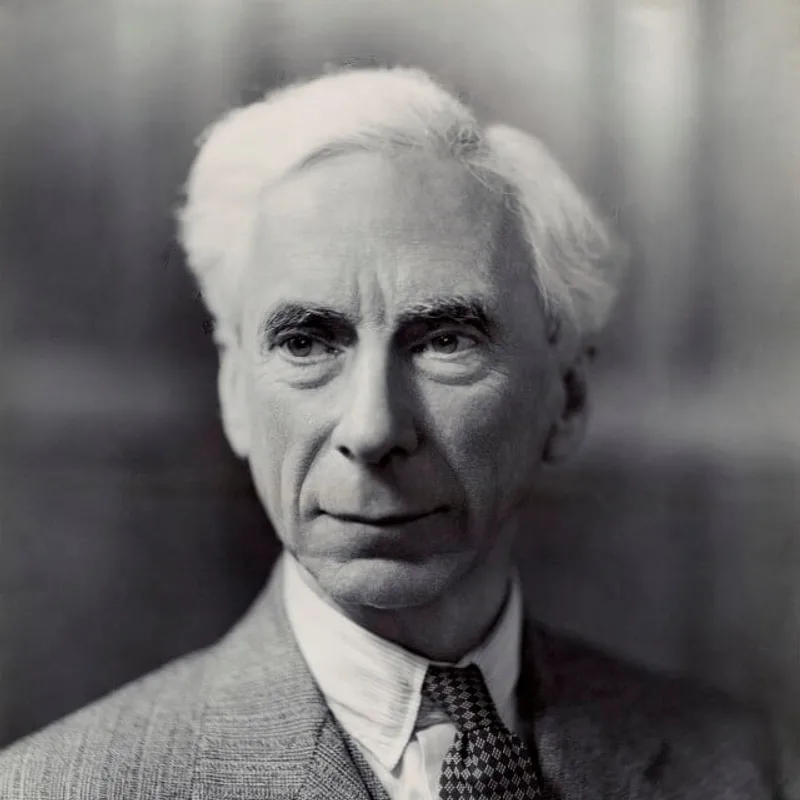
Bertrand Russell
Philosopher, Logician, Essayist, 1872–1970
Agnostic
What is the meaning of life?
Love, knowledge, and pity for suffering; we confer the value ourselves.
Russell did not think the universe hands us a purpose, and he did not miss one. Value, he wrote in What I Believe (1925), is something we confer: it is for us to decide what the good life is, not for Nature, and not for Nature personified as God. His own formula from that book was that the good life is one inspired by love and guided by knowledge. At eighty-four he wrote the prologue to his autobiography, "What I Have Lived For", naming three passions — the longing for love, the search for knowledge and pity for human suffering. He concluded that he had found the life worth living and would gladly live it again.
-
“Three passions, simple but overwhelmingly strong, have governed my life: the longing for love, the search for knowledge, and unbearable pity for the suffering of mankind. These passions, like great winds, have blown me hither and thither, in a wayward course, over a deep ocean of anguish, reaching to the very verge of despair.”1
-
“This has been my life. I have found it worth living, and would gladly live it again if the chance were offered me.”1
-
“The good life is one inspired by love and guided by knowledge.”2
-
“It is we who create value and our desires which confer value. In this realm we are kings, and we debase our kingship if we bow down to Nature. It is for us to determine our good life, not for Nature – not even for Nature personified as God.”2
What is the meaning of the universe?
The universe is just there, and that is all. No purpose.
Russell was a philosophical agnostic who called himself an atheist in plain company: he could not disprove God, but he could not disprove the Homeric gods either. In "A Free Man's Worship" (1903) he set out the picture science left him with — humans as the product of causes with no foresight, destined for extinction with the solar system — and argued that any honest philosophy had to build on it. Asked by the Jesuit Frederick Copleston in a 1948 BBC debate what explains the universe, he said it is just there, and that is all. He saw no purpose in it, and said he had no wish to find one.
-
“I should say that the universe is just there, and that is all.”3
-
“That Man is the product of causes that had no prevision of the end they were achieving; that his origin, his growth, his hopes and fears, his loves and his beliefs, are but the outcome of accidental collocations of atoms; that no fire, no heroism, no intensity of thought and feeling, can preserve individual life beyond the grave … all these things, if not quite beyond dispute, are yet so nearly certain that no philosophy which rejects them can hope to stand.”4
-
“When I come to my own beliefs, I find myself quite unable to discern any purpose in the universe, and still more unable to wish to discern one.”5
-
“As a philosopher, if I were speaking to a purely philosophic audience I should say that I ought to describe myself as an Agnostic … On the other hand, if I am to convey the right impression to the ordinary man in the street I think that I ought to say that I am an Atheist, because, when I say that I cannot prove that there is not a God, I ought to add equally that I cannot prove that there are not the Homeric gods.”6