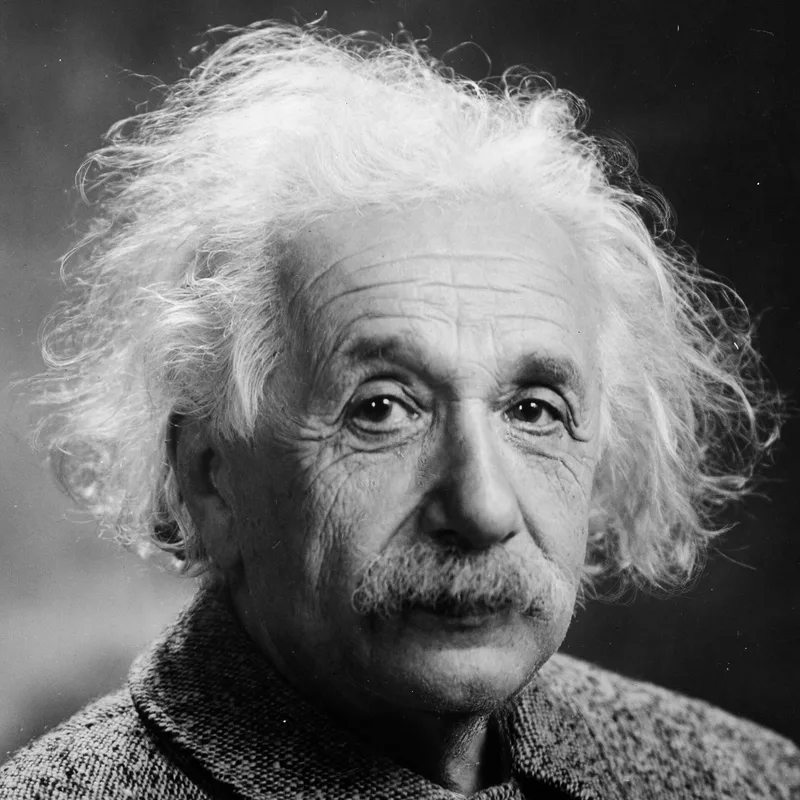
Albert Einstein
Theoretical physicist, 1879–1955
Pantheist
What is the meaning of life?
To live for others, and to keep wondering.
Einstein thought the question itself was a religious one: to ask what life is for is already to step outside science. His own answer was practical. We arrive uninvited, for a short stay, and the one thing daily life makes obvious is that we are here for other people — those we love and the many whose work our lives depend on. He added a second strand: wonder. The capacity to stand amazed in front of the mysterious was, for him, what made a life worth living, and losing it was a kind of death.
-
“What is the meaning of human life, or of organic life altogether? To answer this question at all implies a religion. Is there any sense then, you ask, in putting it? I answer, the man who regards his own life and that of his fellow creatures as meaningless is not merely unfortunate but almost disqualified for life.”1
-
“Our situation on this earth seems strange. Every one of us appears here involuntarily and uninvited for a short stay, without knowing the whys and the wherefore. In our daily lives we only feel that man is here for the sake of others, for those whom we love and for many other beings whose fate is connected with our own.”2
-
“Only a life lived for others is a life worthwhile.”3
-
“The most beautiful experience we can have is the mysterious. It is the fundamental emotion that stands at the cradle of true art and true science. Whoever does not know it and can no longer wonder, no longer marvel, is as good as dead, and his eyes are dimmed.”1
What is the meaning of the universe?
Spinoza's God: lawful harmony, no one listening.
Einstein rejected a personal God who answers prayers or judges people, but he refused the label atheist. He called his position Spinoza's God — a God who reveals himself in the lawful harmony of the world and has no concern for human fate. What he felt in front of the universe he called the cosmic religious sense: a rapturous amazement at the order of nature, revealing an intelligence next to which all human thought is a faint reflection. In his late letter to the philosopher Eric Gutkind he was blunter: the word God was for him only an expression of human weakness.
-
“I believe in Spinoza's God, Who reveals Himself in the lawful harmony of the world, not in a God Who concerns Himself with the fate and the doings of mankind.”4
-
“His religious feeling takes the form of a rapturous amazement at the harmony of natural law, which reveals an intelligence of such superiority that, compared with it, all the systematic thinking and acting of human beings is an utterly insignificant reflection.”5
-
“I am not an Atheist. I do not know if I can define myself as a Pantheist. The problem involved is too vast for our limited minds. We are in the position of a little child entering a huge library filled with books in many languages. The child knows someone must have written these books. It does not know how.”6
-
“The word god is for me nothing more than the expression and product of human weaknesses, the Bible a collection of honourable, but still primitive legends which are nevertheless pretty childish.”7